
Ash trees and emerald ash borer
Emerald ash borer kills ash trees. The Virginia Department of Forestry's guide on managing ash (Forestry Topic FT0035, July 2018) lays out what it has done here:
- It was first found in Virginia in 2003 and eradicated, found again in 2008, and has since built up enough to spread rapidly statewide.
- An infested ash "usually dies within three to five years," and the beetle can infest ash as small as half an inch in diameter.
- Ash becomes brittle shortly after infestation and, in the guide's words, "will pose a safety hazard."
- Insecticide can work if it's applied before more than 30 percent of the canopy is damaged, with re-treatment every one to three years while the beetle is abundant.
- Leaving a dead ash is acceptable only where it isn't a safety hazard, such as deep in the woods away from buildings and trails.
Two programs bear on homeowners. The Virginia Department of Forestry offers emerald ash borer cost-share help for treating and preserving ash, and a separate Ash Removal and Replacement application (form 17.06) for ash lost to the beetle. And Dominion Energy is cutting down ash trees that could affect its distribution lines under a mitigation plan approved by the State Corporation Commission; the debris from a dead-tree removal is the owner's responsibility (both checked Nov 10, 2026).
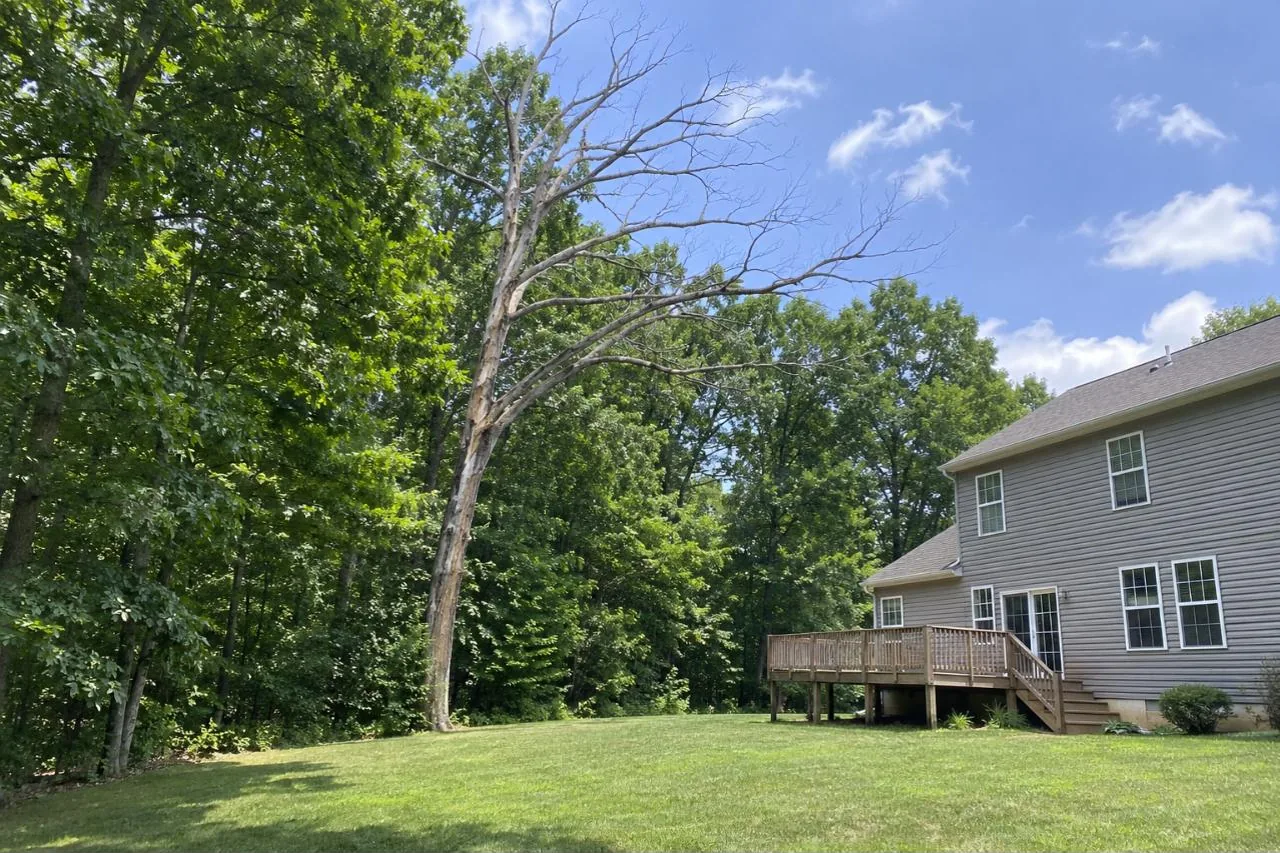
Ash isn't the most common tree here. In Virginia Tech's inventory of Fredericksburg's street trees (2008 data, published 2012), native ash made up 1.24% of the total. But a dead ash at the edge of a backyard is exactly the kind of tree the Forestry guide is warning about.
When a lean is new
A tree that grew at an angle toward the light decades ago is a different case from one that has started tipping. The second kind is the worry. Things worth telling the contractor about:
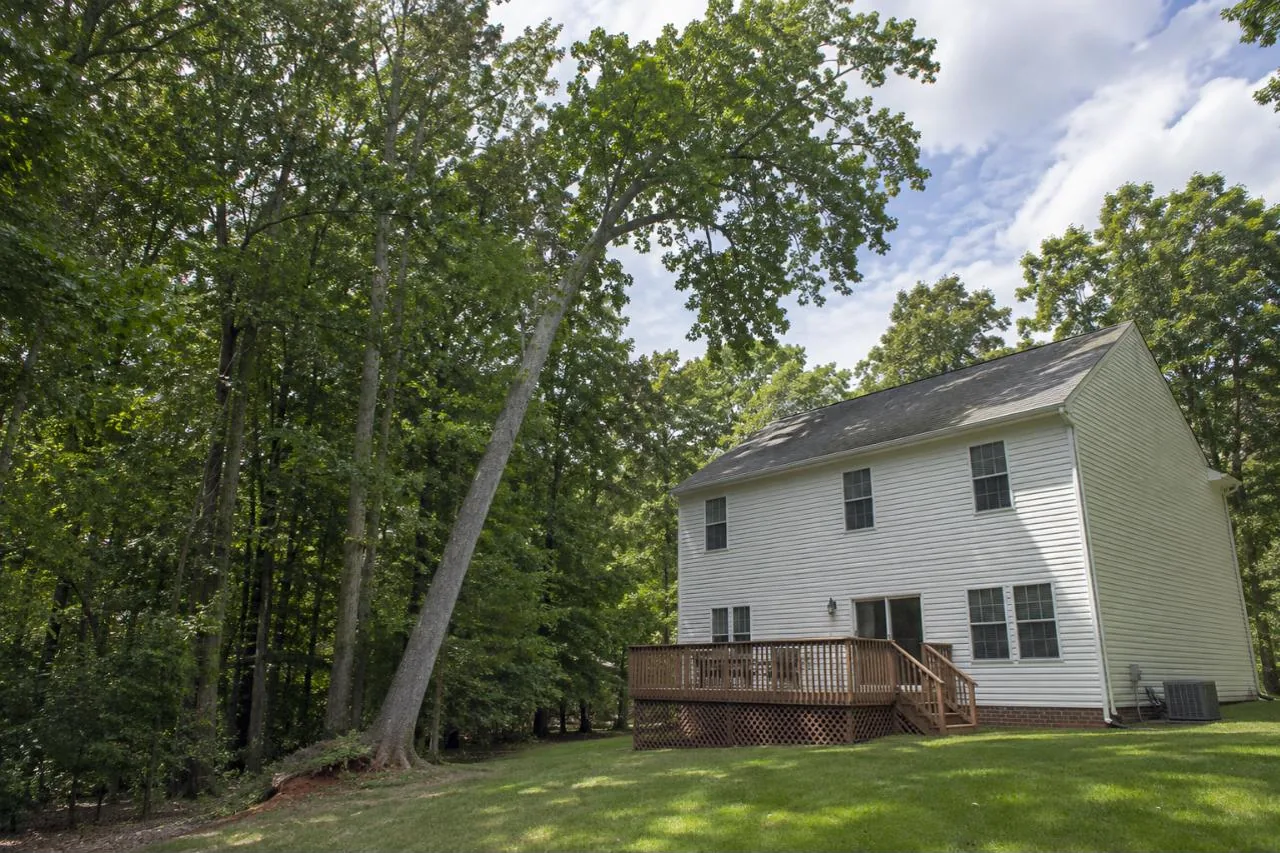
- Soil heaved, cracked or mounded at the base, usually on the side away from the lean, as in the photo above.
- Roots lifting out of the ground or snapped at the surface.
- A lean that wasn't there last year, or that got worse after a storm or a wet winter.
- A gap opening between the trunk and the soil.
The ground plays a part. The University of Florida's guide on wind and trees says shallow soil, a high water table, compaction and cut roots all make a tree more likely to blow over. The Mattaponi soil series, whose type location is in Spotsylvania County, has a seasonal high water table 36 to 72 inches down from December to March (USDA). And NC State Extension describes tulip poplar, one of the tallest trees in local woods, as having a shallow root system.
Other warning signs
- Decay. The UF guide calls decay, caused by fungi that weaken wood, a major cause of tree failure. Mushrooms or conks on the trunk or roots, soft or hollow wood, and cavities are reasons to have a tree checked.
- Split forks. Two stems of similar size from one fork, with bark pinched between them, are very prone to breaking, according to the same guide.
- Dead limbs in the crown. Especially over the roof, the deck or the driveway.
- Root damage. Trenching, a new driveway or an addition close to the trunk. The UF guide warns never to cut roots closer than 5 times the trunk diameter.
- Pines browning. One pine turning rust-brown among green ones can mean beetles or storm damage; see the pine section below.
- A slow decline after a storm. The UF guide says pines can die slowly over 6 months to 2 years after wind storms.
Trees that break most easily here
In the University of Florida's wind-resistance table for the Southeastern Coastal Plain, built from hurricane surveys farther south, tulip poplar, southern red oak and Bradford pear all sit in the lowest group. NC State Extension adds its own notes (checked Nov 10, 2026):
- Tulip poplar: fast growth means weak wood, "susceptible to limb breakage in high winds or from ice/snow," and NC State doesn't recommend it for small residential areas.
- Southern red oak: susceptible to wind damage.
- Bradford pear: "weak crotches that break with age, wind and ice," and relatively short lived.
- Virginia pine: susceptible to wind damage; the USDA Forest Service calls it shallow rooted and subject to windthrow and to ice and snow damage.
- Leyland cypress: shallow roots, and "large specimens tend to topple over." NC State gives it a life span of 20 to 50 years.
The Spotsylvania County trees page covers each species in more depth.
Pines that turn brown
Pine beetles are the usual suspects when one pine browns among green ones. The USDA Forest Service's Silvics manual says loblolly is generally the preferred host of the southern pine beetle, and that Ips engraver beetles kill isolated trees or small groups. It lists southern pine beetle among the principal insects of Virginia pine too, and says heart rot is often present in Virginia pine stands more than 60 years old. The pine tree removal guide goes into all of it.
Dead trees near a stream
Within 100 feet of a year-round stream or its wetlands, the county's Resource Protection Area rules apply even to dead trees. The state regulation allows "dead, diseased, or dying trees or shrubbery and noxious weeds" to be removed from the buffer with local government approval (9VAC25-830-140, checked Nov 10, 2026). The county's handout on the subject says (checked Nov 10, 2026):
- Dead trees or logs may be removed if they pose a fire or falling hazard.
- Diseased or infested trees may be removed if the problem threatens other trees and chemical control would harm the nearby water.
- Removing one to five dead, diseased or storm-damaged trees needs simple administrative approval; more than five needs a permit application.
- Trees within 25 feet of the shoreline should stay unless they threaten to undermine it, and if one there must come down, the stump stays.
- If a hazardous tree has nesting birds or bats, the U.S. Fish and Wildlife Service can give guidance.
The county's RPA page adds that removed dead or diseased trees are replaced with equally effective plantings. Call the Division of Environmental Codes at 540-507-7222 before the work (checked Nov 10, 2026). Details are in the rules guide.
Mistakes with dead and leaning trees
- Waiting on a dead ash. It turns brittle soon after infestation, and a brittle tree near a house is a hazard.
- Climbing or cutting a dead tree yourself. Brittle wood can break where you don't expect.
- Cutting in the buffer first and asking later. Even a dead tree by the creek needs approval, and civil penalties run up to $5,000 a day (checked Nov 10, 2026).
- Ignoring a new lean. A tree that moved once can move again in the next storm.
- Treating an ash too late. The Forestry guide ties treatment to starting before more than 30 percent of the canopy is damaged.
Questions about failing trees
My ash is thinning at the top. Can it be saved?
Possibly, if the canopy damage is under about 30 percent; the Virginia Department of Forestry says insecticide can work before that point, with re-treatment every one to three years. Ask the Department of Forestry about its cost-share program too (checked Nov 10, 2026).
How long does an infested ash take to die?
Usually three to five years, according to the Department of Forestry's July 2018 guide, and the wood turns brittle shortly after infestation.
Can I take down a dead tree in the stream buffer?
Yes, with county approval. For one to five dead, diseased or storm-damaged trees it's a simple administrative approval from Environmental Codes, 540-507-7222 (checked Nov 10, 2026).
The poplar behind the house leans. Is it dangerous?
It depends on whether the lean is old and stable or new and moving. Heaved or cracked soil at the base and roots lifting are reasons to have it looked at soon, especially if it leans toward the house.
Will the power company remove a dead ash near the lines?
Dominion is cutting down ash trees that could affect its distribution lines under its emerald ash borer plan, and the debris is the owner's to handle (checked Nov 10, 2026). REC customers can call 800-552-3904 to ask about trees near co-op lines (checked Nov 10, 2026).
A request about a dead or leaning tree sent from this site goes to one independent contractor who works in Spotsylvania County. The site itself does no tree work.
Sources
- Virginia Department of Forestry, Ash Tree Management: Dealing with the Emerald Ash Borer Invasion (FT0035, July 2018) and Forest Health page (checked Nov 10, 2026); Dominion Energy, tree trimming and power lines (checked Nov 10, 2026).
- Wiseman and Bartens, Virginia Tech, Fredericksburg street tree report, July 2012.
- UF/IFAS, Wind and Trees: Lessons Learned from Hurricanes (FR173); USDA, Mattaponi soil series.
- NC State Extension Gardener Plant Toolbox, tulip poplar, southern red oak, Callery pear, Virginia pine and Leyland cypress. Checked Nov 10, 2026.
- USDA Forest Service, Silvics of North America, Virginia pine and loblolly pine.
- 9VAC25-830-140; Spotsylvania County, What can I do in an RPA?, Chesapeake Bay Preservation and Dead, Diseased, and Dying Vegetation handout. Checked Nov 10, 2026.