
Grind, pull or leave the stump
A stump can go one of three ways. Which one fits depends on where it sits and what you want in that spot next.
- Grinding. A spinning cutter wheel chews the stump down below the surface and turns it into chips mixed with soil. The roots beyond the stump stay in the ground and rot over time. It's the usual choice in a lawn.
- Digging it out. An excavator pulls the stump and its main roots. That leaves a much bigger hole and more torn-up ground. Across a large area, it can cross the county's 2,500-square-foot line for a land disturbance permit (checked Nov 10, 2026).
- Leaving it. At the woods' edge, a stump cut low can simply stay. Near a stream, leaving it may be required; see the buffer section below.
Virginia 811 before the grinder
Virginia's Underground Utility Damage Prevention Act says no excavation or demolition may begin without first submitting a locate request to the notification center, and except in an emergency the digger must wait until every utility operator has marked its lines or reported none, through the positive response system (Va. Code § 56-265.17, checked Nov 10, 2026). Virginia 811's homeowner page names projects that "remove old fence posts or stumps" among its examples of work that needs a locate.
- When to call. At least three working days in advance. Digging can start once all utilities have responded, or after 7:00 a.m. on the third working day after notice (checked Nov 10, 2026).
- How. Dial 811 or 1-800-552-7001, or file online through Exactix. The locate service for public utility lines is free (checked Nov 10, 2026).
- How deep counts. Virginia 811 says, "There is no allotted depth before a person needs to contact Virginia 811," and warns that utilities can be just a few inches below the surface (checked Nov 10, 2026).
- How long the marks last. A locate request is valid for 15 working days from 7:00 a.m. on the next working day after it's made. A re-mark request goes in three working days before it expires, or sooner if the marks fade (Va. Code § 56-265.17, checked Nov 10, 2026).
- What skipping it costs. An excavator, other than a county, city or town, who willfully fails to submit a request is liable to the utility for three times the cost of repairing the damage (same section, checked Nov 10, 2026).
Usually the contractor running the grinder places the request. Ask for the ticket number and look for the paint and flags before the work starts.
The lines 811 won't mark
Virginia 811 says, "All private utility lines should be marked by the owner before excavation begins." Public utilities mark their lines only to the meter or similar connection point, so the water line from the meter to the house is private. Virginia 811's page on private utilities lists lines from the house to a detached garage or shed, invisible pet fences, septic tanks and their lines, and propane tanks and their lines (both pages checked Nov 10, 2026). A line from a private well, landscape lighting wires and irrigation pipes are private too. Point them out to the contractor, mark them with flags if you know where they run, and mention any spot where you're unsure.
Red clay and the hole left behind
The USDA's Mattaponi soil series, whose type location is in Spotsylvania County, has a brownish-yellow to reddish-yellow clay to sandy clay loam subsoil and a seasonal high water table 36 to 72 inches down from December to March. Other Piedmont soils found in Virginia include deep red clays like the Cecil series and shallow ones like the Louisa series, which reaches rock about 21 inches down in its typical profile and carries flakes of mica (USDA soil series descriptions). Which of these lie under a given yard wasn't confirmed for this site.
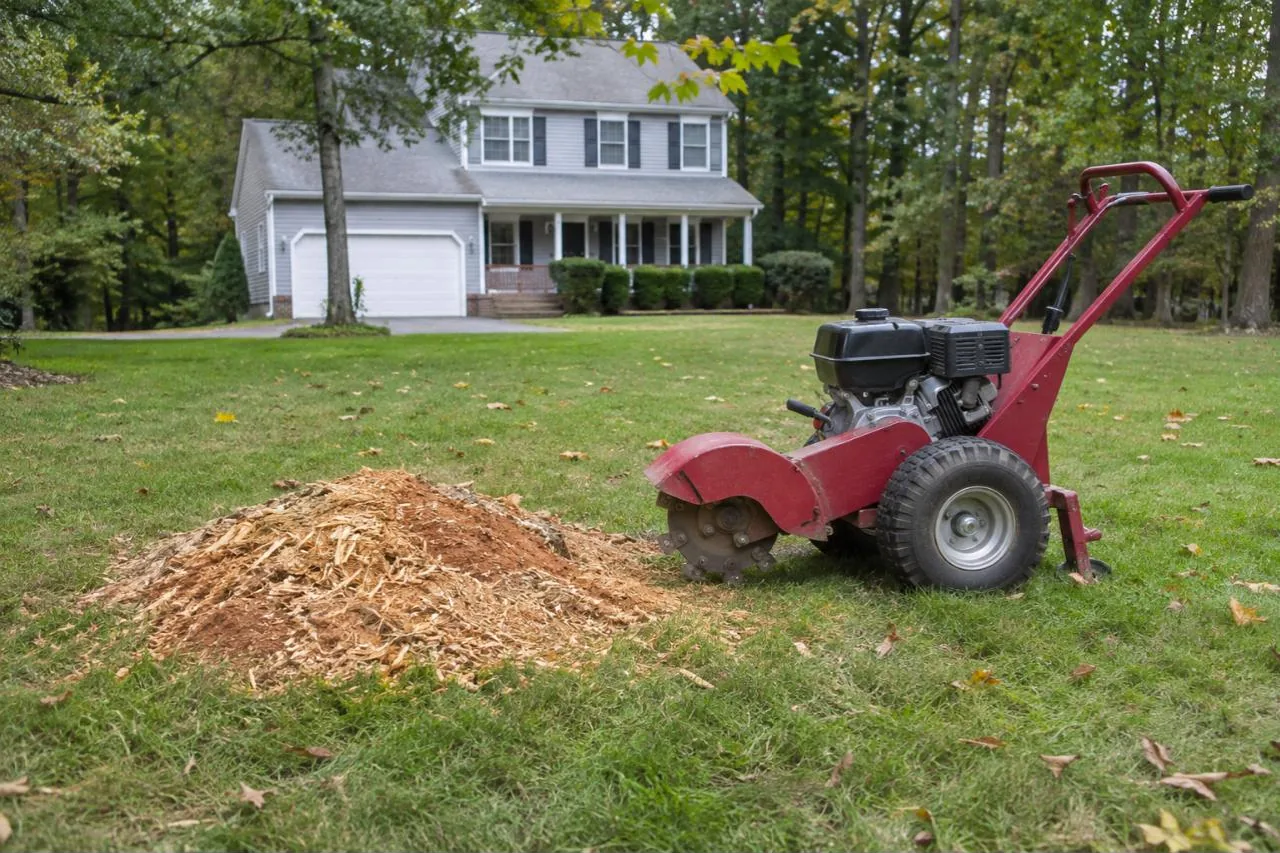
When a grinder works a stump in clay, the result is what you see in the photo above: a mound of chips stained red. The mound shrinks as the chips settle and the buried wood rots, so a hole filled level with the lawn tends to sink later. Many homeowners rake the chips out, backfill with topsoil a little above grade, and seed or sod. If the cutter wheel hits rock in shallow ground, the grind stops where the rock is.
Stumps near a creek or pond
Inside a Chesapeake Bay Resource Protection Area, the 100-foot buffer along year-round streams and their wetlands, the county says removing vegetation or disturbing land generally needs county approval (checked Nov 10, 2026). Its handout on dead, diseased and dying vegetation adds that trees within 25 feet of the shoreline should stay unless they threaten to undermine it, and if one there must come down, the stump is left in place to hold the soil.
So a stump right at the creek bank may need to stay where it is. Farther back in the buffer, ask the Division of Environmental Codes at 540-507-7222 before grinding (checked Nov 10, 2026). The rules guide explains the buffer in full.
Surface roots around the stump
Several common trees here leave a web of shallow roots behind. NC State Extension describes red maple's "dense mat of surface roots" that may buckle nearby sidewalks or driveways, and notes shallow root systems on sweetgum and tulip poplar (checked Nov 10, 2026). The Forest Service describes Virginia pine's root system as relatively shallow except on deep sands, and loblolly as having a short taproot and then an extensive lateral root system.
Grinding the stump doesn't remove those surface roots. If they run under the lawn where you plan to mow or plant, ask for them to be ground out too, and expect the price to reflect it.
Where the chips go
- No county facility takes stumps. The county says stumps aren't accepted at any refuse facility (checked Nov 10, 2026). They're ground on site or hauled away by the contractor.
- Bulk chips go only to Livingston Landfill. Bulk wood chips count as clearing debris and go only to Livingston at 6241 Massey Road, not to the convenience centers. They have to be clean, and the county doesn't accept yard waste mixed with dirt (checked Nov 10, 2026), so clay-stained grindings are a poor fit for drop-off.
- On the property. Chips make good mulch for beds and paths away from the house.
What stump grinding costs
Thumbtack's tree removal cost guide, last updated March 24, 2026, puts grinding alone at about $307 to $426 nationally (checked Nov 10, 2026). By trunk diameter:
| Stump diameter | National average (Thumbtack, checked Nov 10, 2026) |
|---|---|
| Less than 1 foot across | $267 to $354 |
| 1 to 2 feet across | $324 to $443 |
| 2 to 3 feet across | $355 to $486 |
| 3 to 4 feet across | $372 to $494 |
Lawn Love's 2026 guide, which cites no data source, says stump removal adds $180 to $525 to a tree removal (checked Nov 10, 2026). Surface roots, rock, a tight gate and hauling the grindings all add to the price. These are national figures; the contractor's written price is what counts. See what tree work costs.
Stump mistakes to avoid
- Grinding before the marks are down. No ticket, no grinding.
- Forgetting private lines. Nobody from 811 marks the well line or the line to the shed.
- Grinding at the creek bank. Within 25 feet of the shoreline in a buffer, the stump usually stays.
- Filling the hole flush. It settles. Leave it a little high.
- Assuming the chips can go to the dump. Grindings mixed with clay don't fit the county's clean-debris rule.
When grinding isn't the answer
Dozens of stumps across a lot being cleared for a house or a pasture is a land clearing job, where an excavator and the land disturbance permit come in. A stump that has to stay by a creek can be cut low and left. And if the tree is still standing, start with tree removal.
Stump questions
Do I really need to call 811 just to grind one stump?
Virginia 811 lists removing old stumps among jobs that need a locate, and says there's no allotted depth before you need to contact it. The service is free; give it at least three working days (checked Nov 10, 2026).
How long are the 811 marks good for?
Fifteen working days from 7:00 a.m. on the working day after the request, under Va. Code § 56-265.17 (checked Nov 10, 2026).
Can I take the grindings to the landfill?
Stumps aren't accepted at any county refuse facility. Clean bulk chips go to Livingston Landfill, but yard waste mixed with dirt isn't accepted (checked Nov 10, 2026). Spreading the chips on site is usually simpler.
The stump is right at the edge of the creek. Can it be ground?
If it's within 25 feet of the shoreline in a Resource Protection Area, the county's guidance is to leave the stump in place to hold the soil. Ask Environmental Codes at 540-507-7222 first (checked Nov 10, 2026).
What does grinding a big oak stump cost?
Thumbtack's national averages run $355 to $486 for a 24- to 36-inch stump and $372 to $494 for 36 to 48 inches (checked Nov 10, 2026). Roots and access can push that up.
A stump request sent from this site goes to one independent contractor who works in Spotsylvania County. The site itself owns no grinder.
Sources
- Va. Code § 56-265.17; Virginia 811, homeowners, private utilities and excavators pages. Checked Nov 10, 2026.
- USDA official soil series descriptions, Mattaponi, Cecil and Louisa.
- Spotsylvania County, What can I do in an RPA?, Dead, Diseased, and Dying Vegetation handout, Environmental page, Yard Waste Collection Program and Solid Waste Center Information. Checked Nov 10, 2026.
- NC State Extension Gardener Plant Toolbox, red maple, sweetgum and tulip poplar (checked Nov 10, 2026); USDA Forest Service, FEIS, Pinus virginiana and Silvics of North America, loblolly pine.
- Thumbtack, Tree Removal Cost Guide 2026, updated March 24, 2026; Lawn Love, How Much Does Tree Removal Cost in 2026?, updated October 5, 2026. Both checked Nov 10, 2026.