
Virginia pine or loblolly?
Virginia Tech's inventory of Fredericksburg's street trees (2008 data, published July 2012) found Virginia pine made up 6% of them, tied with sugar maple and crapemyrtle and behind only red maple and sweetgum. Loblolly is the pine the USDA Forest Service calls "generally the preferred host of the southern pine beetle." Here is how the two stack up in the sources this site used:
| Virginia pine | Loblolly pine | |
|---|---|---|
| Size and growth | 40 to 80 feet tall, 10 to 30 feet wide; slow growing (NC State) | 60 to 90 feet tall, 20 to 40 feet wide; "the most rapid growth rate of all pines" (NC State) |
| Roots | "Shallow rooted" (USDA Silvics); relatively shallow except on deep sands (USDA FEIS) | A short taproot, then an extensive lateral root system (USDA Silvics) |
| Wind, snow and ice | Subject to windthrow and to damage from ice and snow (Silvics); susceptible to wind damage (NC State) | Large dominant trees more vulnerable to high winds; greater damage frequently from ice or glaze storms (Silvics) |
| Age | Decline usually sets in around 65 to 90 years, and trees rarely live past 150 (FEIS) | Not addressed in the sources used here |
| Main insects | Southern pine beetle, Ips beetles, Virginia pine sawfly, redheaded pine sawfly, pales weevil | Southern pine beetle (its preferred host), Ips engraver beetles |
| Main diseases | Heart rot and pitch canker | Fusiform rust, its most serious stem disease, and annosus root rot in thinned stands |
NC State Extension pages checked Nov 10, 2026. NC State adds that Virginia pine grows in "eroded and poor, dry soils." If you aren't sure which pine you have, the contractor can tell on the visit; the problems overlap enough that the plan is often the same.
Snow, ice and snapped tops
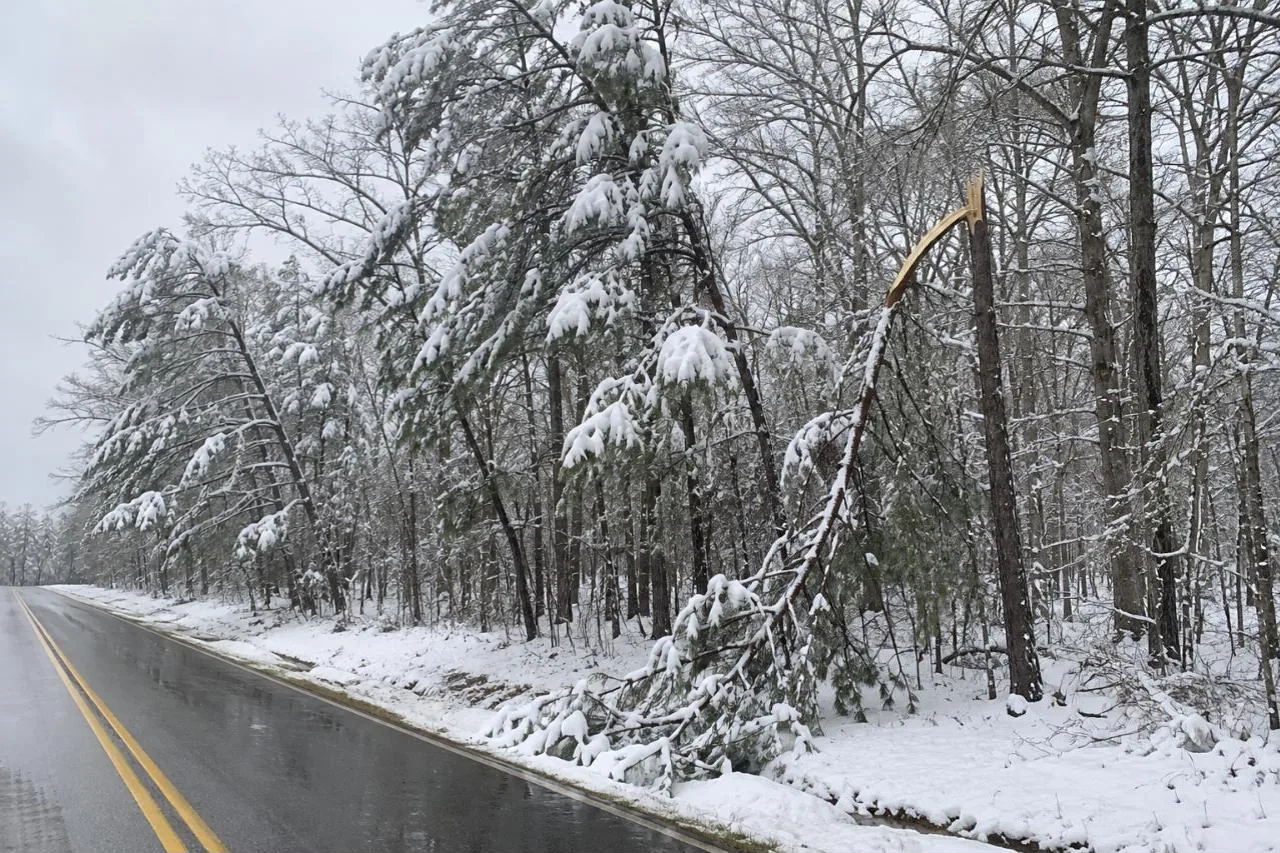
The Forest Service's Silvics manual says Virginia pine is "subject to windthrow and to damage from ice and snow." For loblolly it goes further: "Greater damage frequently occurs from ice or glaze storms," with branches and stems breaking, trees bending and sometimes uprooting. The damage is worse in recently thinned plantations and in dense stands of slender trees with small crowns.
Spotsylvania gets exactly that kind of storm. On January 3, 2022, VDOT's Fredericksburg District totaled 14.6 inches of heavy, wet snow that fell after up to two inches of rain, and a briefing to the Commonwealth Transportation Board reported that "wet, heavy snow caused widespread downed trees that blocked roads." That report was about trees in general, not pines alone. Still, a pine bent over by snow or carrying a snapped top above a house, a driveway or a road is one to have looked at soon.
When the woods around them are cleared
A pine that grew up in a crowded stand never had to face the wind alone. Take its neighbors away and it does. The Silvics manual describes this in forestry terms. For Virginia pine, windthrow losses are "likely to occur if old stands are thinned excessively"; in one thinned 17-year-old stand, windthrow wiped out the whole gain from thinning, and thinning is "not recommended" in older stands, though windthrow "is not serious in younger stands." For loblolly, windthrow is most common on shallow, coarse soils and in recently thinned stands.
Those findings come from forest stands, not house lots, but they match a common house-lot situation: a lot is cleared for a house, and a few tall pines are left standing near it. Or the neighbor clears their side, and your pines at the property line are suddenly on the edge. Those are the pines to watch for a new lean, cracked soil at the base or a top that sways more than it used to.
Age, heart rot and decline
Virginia pine doesn't live as long as the oaks around it. The Forest Service's Fire Effects Information System says senescence "usually occurs around 65 to 90 years," and trees rarely live past 150. Silvics adds that heart rot, caused by the fungus Phellinus pini, "often is present in stands more than 60 years old, but it is rare in stands less than 50 years of age." On better sites, the same sources put Virginia pine at 50 to 75 feet tall by age 50, and the record tree at 114 feet.
Heart rot works inside the trunk, so an old Virginia pine can look healthy from the yard while its center softens. Conks on the bark, dead limbs high in the crown and a thinning top are reasons to have an older pine near the house checked.
Pine beetles and brown crowns
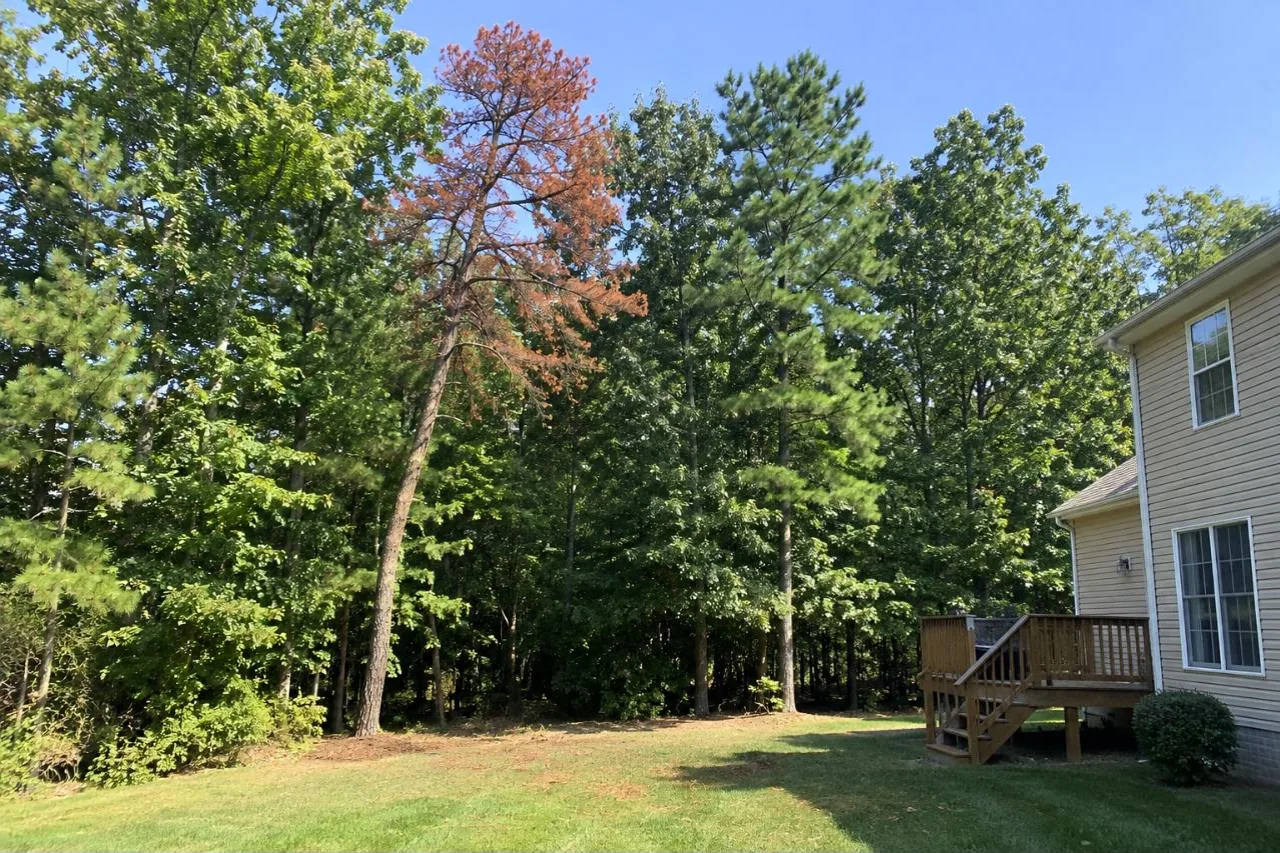
A single pine turning rust-brown among green trees often means insects. The Silvics manual says Ips engraver beetles kill isolated trees or small groups, and that loblolly is the southern pine beetle's preferred host. It lists the southern pine beetle and pine sawflies as Virginia pine's principal insects, and notes that trees stressed by lightning, fire or logging injury are more susceptible. NC State Extension adds pitch canker and the southern pine sawyer among Virginia pine's "numerous pest and disease problems."
The Virginia Department of Forestry lists a Pine Bark Beetle Prevention Program with cost-share forms, and its Forest Health Review for December 2025 covers pine bark beetles (checked Nov 10, 2026). Recent beetle counts for Spotsylvania itself weren't available for this site. What matters at home is simpler: a dead pine near the house, the drive or the wires should come down before its top and limbs do.
Pines after a storm
A pine that rode out a storm isn't necessarily fine. The University of Florida's guide on wind and trees says pines can die slowly over 6 months to 2 years after wind storms, from root and stem damage that doesn't show at first. If a pine near the house starts to brown in the months after a big blow, storm damage may be the reason. Rappahannock Electric Cooperative says 70% of its outages come from trees growing outside its rights-of-way (February 25, 2025), so pines along a road or a service line matter to more than one household.
How a tall pine comes down near a house
A loblolly can reach 60 to 90 feet, and a straight pine trunk tempts people to drop it whole. Near a house, a fence or wires, that's rarely safe. The usual plan:
- Check the top. A dead or snapped top can break loose when the trunk is cut or climbed, so the crew decides first whether to climb, use a bucket truck or bring a crane.
- Limb it from the top down. Branches are cut and dropped into a clear zone or lowered on rope.
- Take the trunk in sections. Short lengths lowered or dropped where they won't hit anything.
- Deal with the brush. Pine limbs make a lot of it. The county has no curbside pickup, convenience centers take limbs only under 6 inches thick and 6 feet long, and Livingston Landfill takes no logs over 18 inches across or 12 feet long (checked Nov 10, 2026).
- Grind the stump, or leave it. Virginia 811 lists stump removal among jobs that need a locate (checked Nov 10, 2026). See stump grinding.
Pines in the stream buffer
A dead or beetle-killed pine within 100 feet of a year-round stream or its wetlands sits in a Resource Protection Area. The county's handout says dead trees may be removed if they pose a fire or falling hazard, and infested trees may be removed if the problem threatens other trees and chemical control would harm nearby water. One to five trees need simple administrative approval; more than five need a permit application (checked Nov 10, 2026). Call Environmental Codes at 540-507-7222 first, and see the rules guide.
What pine removal costs
Thumbtack's tree removal cost guide (updated March 24, 2026) prices by trunk diameter and canopy, not species. A 12- to 24-inch trunk with a canopy wider than 30 feet averages $808 to $2,132 nationally, and a 24- to 36-inch trunk with a canopy over 30 feet $1,562 to $4,117 (checked Nov 10, 2026). Lawn Love's 2026 guide, which cites no data source, gives $870 to $1,160 for trees 60 to 80 feet tall and $1,160 to $2,000 above 80 feet (checked Nov 10, 2026). A dead top, a lean toward the house or wires nearby push the price up. These are national figures; the contractor's written price is the one that counts. More on what tree work costs.
Pine questions
The pines left after our lot was cleared sway a lot more now. Should I worry?
It's worth a look. The Forest Service found windthrow losses are likely when older Virginia pine stands are thinned heavily, and loblolly blows over most often in recently thinned stands. Watch for a new lean or cracked soil at the base.
Why did one pine turn brown when the others are green?
Ips engraver beetles kill isolated trees or small groups, according to the Silvics manual, and storm damage can kill a pine slowly over 6 months to 2 years, according to the University of Florida. Either way, a dead pine near the house should come down.
How long do Virginia pines live?
The Forest Service says decline usually sets in around 65 to 90 years, and trees rarely live past 150. Heart rot is often present in stands more than 60 years old.
Is there any help with beetle-damaged pines?
The Virginia Department of Forestry's Pine Bark Beetle Prevention Program offers cost-share for prevention work in pine stands, such as thinning young pines and restoring longleaf pine (checked Nov 10, 2026). It's aimed at forest land, not a single yard tree, so ask the Department whether your land fits.
Do I need permission to cut a dead pine by the creek?
If it's within the 100-foot Resource Protection Area, yes. One to five dead or storm-damaged trees need simple administrative approval from the county (checked Nov 10, 2026).
A pine request sent from this site goes to one independent contractor who works in Spotsylvania County. The site itself cuts no trees.
Sources
- USDA Forest Service, Silvics of North America: Carter and Snow, Virginia pine; Baker and Langdon, loblolly pine.
- USDA Forest Service, Fire Effects Information System, Sullivan (1993), Pinus virginiana.
- NC State Extension Gardener Plant Toolbox, Virginia pine and loblolly pine. Checked Nov 10, 2026.
- Wiseman and Bartens, Virginia Tech, Fredericksburg street tree report, July 2012.
- Commonwealth Transportation Board, Winter Storm Frida update, January 2022; UF/IFAS, Wind and Trees (FR173); Rappahannock Electric Cooperative, tree-caused outages, February 25, 2025.
- Virginia Department of Forestry, Forest Health page; Spotsylvania County, Dead, Diseased, and Dying Vegetation handout, Yard Waste Collection Program; Virginia 811, homeowners page. Checked Nov 10, 2026.
- Thumbtack, Tree Removal Cost Guide 2026, updated March 24, 2026; Lawn Love, How Much Does Tree Removal Cost in 2026?, updated October 5, 2026. Both checked Nov 10, 2026.