
Yard trees at a glance
| Tree | Typical size | How it tends to fail | UF wind group |
|---|---|---|---|
| Tulip poplar | 80 to 120 ft tall; rapid growth | Weak wood; limbs break in high winds or from ice and snow; shallow roots | Lowest |
| Southern red oak | 60 to 100 ft tall | Susceptible to wind damage | Lowest |
| Bradford (Callery) pear | Up to 50 ft tall; fast | Weak crotches that break with age, wind and ice | Lowest |
| White oak | Generally 80 to 100 ft tall; slow | Susceptible to wind damage; sensitive to soil compaction | Medium-Low |
| Willow oak | 40 to 75 ft, up to 100; fast | Susceptible to wind damage | Medium-Low |
| Red maple | Commonly 40 to 70 ft; fairly fast | Some branches break in wind and ice; dense mat of surface roots | Medium-Low |
| Sweetgum | 60 to 100 ft tall; rapid | Shallow root system | Medium-High |
| Virginia pine | 40 to 80 ft tall; slow | Shallow rooted; windthrow; ice and snow damage | Not listed |
| Loblolly pine | 60 to 90 ft tall; very fast | Wind damage; breakage in ice and glaze storms | Not given here |
| Leyland cypress | 60 to 70 ft tall, 10 to 15 ft wide | Shallow roots; large ones tend to topple | Not given here |
The University of Florida's groups come from surveys after hurricanes in the Southeastern Coastal Plain, not from Virginia, so read them as a general guide. Virginia pine isn't in that table, and the table's layout made the groups for loblolly and Leyland cypress hard to read with confidence, so none is given for them here.
Tulip poplar
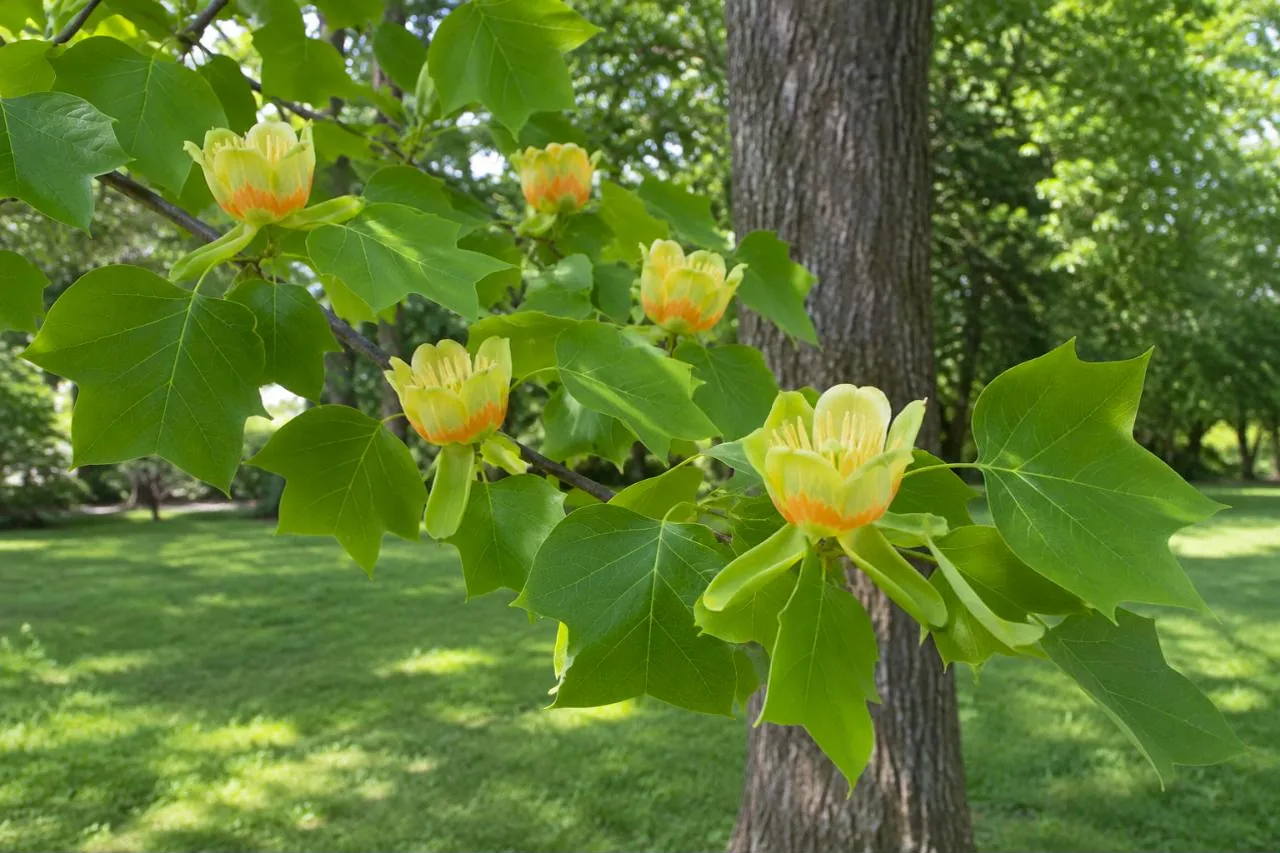
Tulip poplar is one of the tallest trees on this page. NC State Extension lists it at 80 to 120 feet tall and 30 to 60 feet wide, with rapid growth, and is blunt about the cost of that speed: "Fast-growing means they are weak-wooded and susceptible to limb breakage in high winds or from ice/snow." It has a shallow root system, and NC State doesn't recommend it as a street tree or in small residential areas. Its listed problems include aphids and scale insects that leave sooty mold, verticillium wilt and cankers (checked Nov 10, 2026). The University of Florida's wind table puts it in the lowest group.
At those sizes, a mature poplar at the back of the lot stands far above a two-story house. The ones worth watching are those with long limbs over the roof, dead wood high in the crown, or a new lean.
The oaks
White oak grows slowly to generally 80 to 100 feet, sometimes 135, with a spread of 50 to 80 feet and a deep taproot. NC State calls it sensitive to soil compaction and susceptible to wind damage, and lists oak wilt, anthracnose and cankers among its problems (checked Nov 10, 2026). Driveways, additions and heavy trucks over its roots all compact that soil.
Willow oak grows fast to 40 to 75 feet, sometimes 100. It made up 5% of Fredericksburg's street trees in Virginia Tech's inventory (2008 data) and ranked among the most important by leaf area and canopy. NC State notes it's susceptible to wind damage and lists shoestring root rot, oak wilt, cankers and borers (checked Nov 10, 2026).
Southern red oak reaches 60 to 100 feet. NC State says it's susceptible to wind damage and that, "except for oak wilt, no pests or diseases are of major concern"; fall cankerworm is listed too (checked Nov 10, 2026). The UF wind table puts it in the lowest group.
For any oak you're keeping during construction or a nearby removal, the UF storm guide's rule applies: never cut roots closer than 5 times the trunk diameter.
Red maple and sweetgum
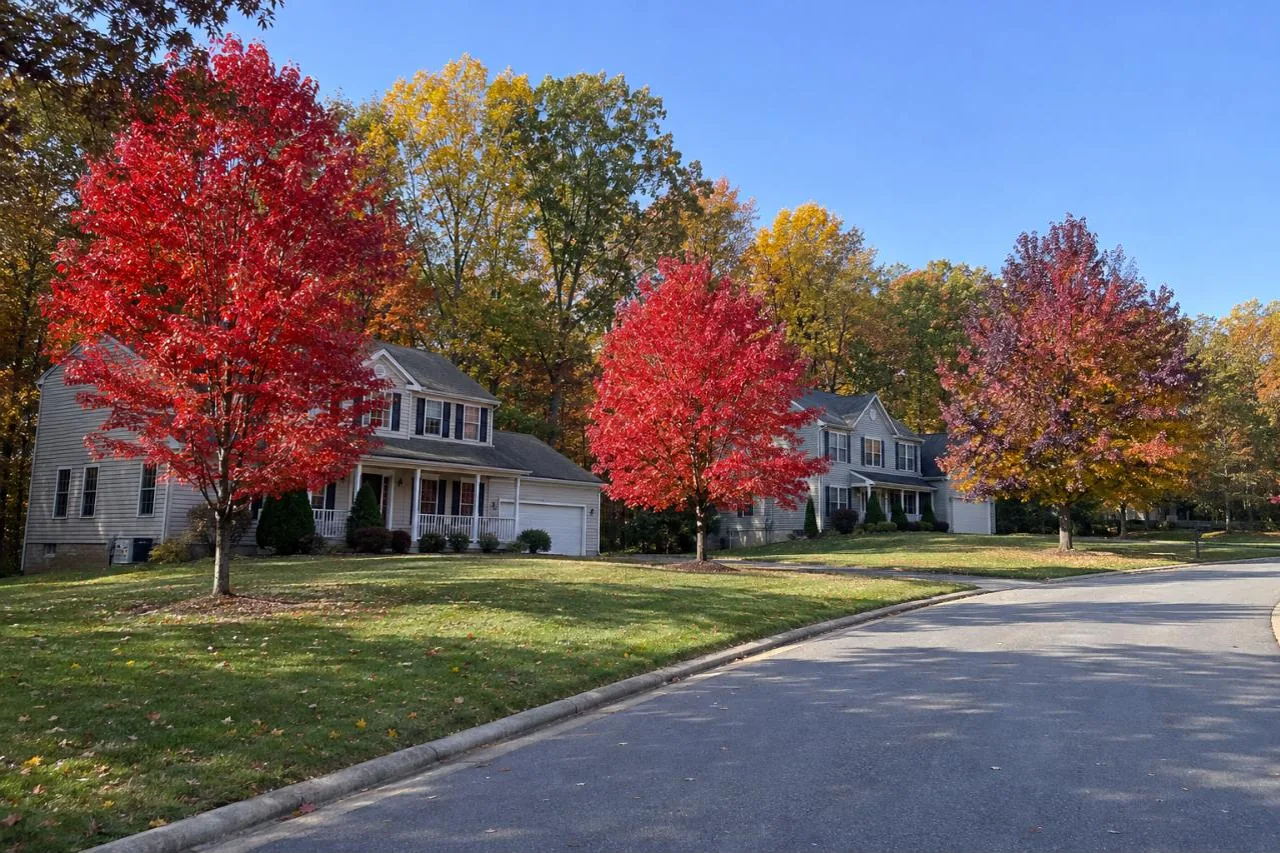
Red maple was the most common street tree in Virginia Tech's Fredericksburg inventory, at 13%, with sweetgum second at 8% (2008 data, published 2012).
Red maple commonly grows 40 to 70 feet, occasionally to 120. NC State describes "a dense mat of surface roots" that "may buckle nearby sidewalks or driveways," and notes that "wind and ice may break some branches." Verticillium wilt, which NC State says "can be fatal," cankers, root rots and borers are its main problems (checked Nov 10, 2026).
Sweetgum grows rapidly to 60 to 100 feet with a 40- to 50-foot spread and "has a shallow root system." NC State lists wood rot, bleeding necrosis and borers, plus the familiar spiky gumballs (checked Nov 10, 2026). The UF table places it in the medium-high wind group.
Virginia pine and loblolly
Virginia pine made up 6% of Fredericksburg's street trees in the Virginia Tech inventory (2008 data). The USDA Forest Service calls it shallow rooted and subject to windthrow and to damage from ice and snow, and says it usually declines around 65 to 90 years of age. Loblolly grows faster and taller, to 60 to 90 feet, and is the southern pine beetle's preferred host. Both are covered in depth on the pine tree removal page.
Bradford pear and Leyland cypress
Bradford, or Callery, pear grows fast to about 50 feet. NC State describes "weak crotches that break with age, wind and ice," warns that heavy wind and rainstorms are likely to split a 'Bradford' in half at its tight crotches, and calls the tree relatively short lived (checked Nov 10, 2026). Callery pear made up 4% of Fredericksburg's street trees in 2008 and ranked among the most important by leaf area. It's on the Virginia Invasive Plant Species List, September 2024 edition, with a "Medium" invasiveness rank; tree-of-heaven is ranked "High." The Department of Conservation and Recreation notes the list itself "has no regulatory authority" (checked Nov 10, 2026).
Leyland cypress reaches 60 to 70 feet tall and 10 to 15 feet wide, growing up to 3 feet a year when young. NC State says "large specimens tend to topple over," that Seiridium and Botryosphaeria cankers, often after drought, can't be cured, and that bagworms "can defoliate an entire tree in a matter of a few weeks." It gives the tree a life span of 20 to 50 years (checked Nov 10, 2026).
Ash
Native ash made up just 1.24% of Fredericksburg's street trees in Virginia Tech's 2008 inventory, which named emerald ash borer among the most damaging pests threatening Virginia's street trees. The Virginia Department of Forestry says the beetle has spread rapidly statewide since 2008, and that an infested ash usually dies within three to five years and turns brittle (July 2018). The dead or leaning trees page covers treatment, cost-share and removal.
The ground under them
The USDA's Mattaponi soil series takes its type location from Spotsylvania County. Its official description places it in the Atlantic Coastal Plain and Fall Line Region of Virginia and the Carolinas, formed in river and marine sediments and as a capping over the Piedmont. It's very deep, with a clay subsoil and a seasonal high water table 36 to 72 inches down from December to March, and its sample profile was described in a naturally reseeded mixed pine and hardwood forest (revised October 2021).
Just over the county line, the Nason series takes its type location from Orange County, two miles north of Rhoadesville. It's well drained, with soft schist bedrock 40 to 60 inches down and yellowish-red silty clay at depth. Other Piedmont series described as occurring in Virginia include Cecil, with red clay subsoil; Appling, with strong brown clay; Tatum, red to yellowish-red over schist and phyllite; and Louisa, a shallow, gravelly soil with flakes of mica and rock about 21 inches down in its typical profile. Which of these are mapped in Spotsylvania wasn't confirmed for this site. The county runs from sea level to 540 feet in elevation (county website, checked Nov 10, 2026).
Why it matters: the University of Florida's storm guide lists shallow soil and a high water table among the conditions that make trees more likely to blow over.
Pests on Virginia's lists
- Spongy moth. Virginia's quarantine regulation (2VAC5-330-30, last amended effective April 5, 2017) lists all of Spotsylvania County and all of the City of Fredericksburg as regulated areas, along with Caroline, Orange, Louisa, Stafford, Culpeper and Hanover. The state agriculture department calls it "a destructive, exotic forest pest"; it was known as gypsy moth until the Entomological Society of America renamed it on March 2, 2022 (checked Nov 10, 2026).
- Spotted lanternfly. First found in Virginia in 2018 and now in more than half of the state's counties and independent cities. Virginia repealed its quarantine as of March 27, 2025. Stafford, Caroline, Orange and Culpeper are on the state's list of places where reports are no longer needed; Spotsylvania and Fredericksburg aren't (checked Nov 10, 2026).
- Emerald ash borer. Found again in Virginia in 2008 and spreading rapidly statewide, per the Department of Forestry's July 2018 guide.
- Pine beetles. Southern pine beetle and Ips engravers attack Virginia pine and loblolly. The Department of Forestry runs a Pine Bark Beetle Prevention Program (checked Nov 10, 2026).
- Beech leaf disease. The Department of Forestry's December 2025 Forest Health Review covers it. Whether it has reached Spotsylvania wasn't confirmed for this site.
What storms have shown
Heavy wet snow on January 3, 2022 brought down trees across Virginia and blocked roads, with 10.8 to 14.6 inches across Spotsylvania, Stafford and Fredericksburg. On April 19, 2013, an EF-1 tornado uprooted trees in Fredericksburg while gusts of around 80 mph damaged trees in the county. Rappahannock Electric Cooperative says trees cause 70% of its outages (checked Nov 10, 2026). The storm guide has the full record.
If you're replanting
In a stream buffer, the county prefers native species for replanting and sets the number of plants by area (checked Nov 10, 2026). Elsewhere, two cautions from this page: Callery pear is on the state's invasive list, and tulip poplar, by NC State's own advice, isn't suited to small residential spaces.
Questions about local trees
Which tree near my house should I worry about most?
There's no single answer, but the sources on this page point to dead ash, aging Virginia pines, Bradford pears and big tulip poplars with long limbs over the roof. Tulip poplar, Bradford pear and southern red oak sit in the lowest group of the UF wind table.
Is Bradford pear banned in Virginia?
Callery pear is on the Virginia Invasive Plant Species List with a Medium rank, but the Department of Conservation and Recreation says the list has no regulatory authority (checked Nov 10, 2026). A sales ban wasn't confirmed for this site.
Is Spotsylvania under a spongy moth quarantine?
Yes. The state regulation lists all of Spotsylvania County and the City of Fredericksburg (2VAC5-330-30, checked Nov 10, 2026).
Why are the roots of my red maple lifting the driveway?
NC State Extension describes red maple's "dense mat of surface roots" that may buckle nearby sidewalks or driveways (checked Nov 10, 2026).
Should I report a spotted lanternfly?
Spotsylvania and Fredericksburg aren't on the state's list of localities where reports are no longer needed, so check the Virginia Department of Agriculture and Consumer Services page for how to report one (checked Nov 10, 2026).
A request about any of these trees sent from this site goes to one independent contractor who works in Spotsylvania County. The site itself does no tree work.
Sources
- NC State Extension Gardener Plant Toolbox: tulip poplar, white oak, willow oak, southern red oak, red maple, sweetgum, Virginia pine, loblolly pine, Callery pear and Leyland cypress. Checked Nov 10, 2026.
- Duryea and Kampf, UF/IFAS, Wind and Trees: Lessons Learned from Hurricanes (FR173).
- Wiseman and Bartens, Virginia Tech, Fredericksburg street tree report, July 2012 (2008 inventory).
- USDA Forest Service, Silvics of North America, Virginia pine and loblolly pine; FEIS, Pinus virginiana.
- Virginia DCR, Virginia Invasive Plant Species List, September 2024 (checked Nov 10, 2026).
- Virginia Department of Forestry, Ash Tree Management (FT0035, July 2018) and Forest Health page (checked Nov 10, 2026).
- USDA official soil series descriptions: Mattaponi, Nason, Cecil, Appling, Tatum and Louisa; Spotsylvania County, About Spotsylvania (checked Nov 10, 2026).
- 2VAC5-330-30; Virginia Department of Agriculture and Consumer Services, spongy moth and spotted lanternfly pages. Checked Nov 10, 2026.
- CNA after-action report, March 2022; NWS Storm Data, April 2013; Rappahannock Electric Cooperative, "Pruning With a Purpose" (checked Nov 10, 2026); Spotsylvania County, Mitigation Plans handout (checked Nov 10, 2026).