
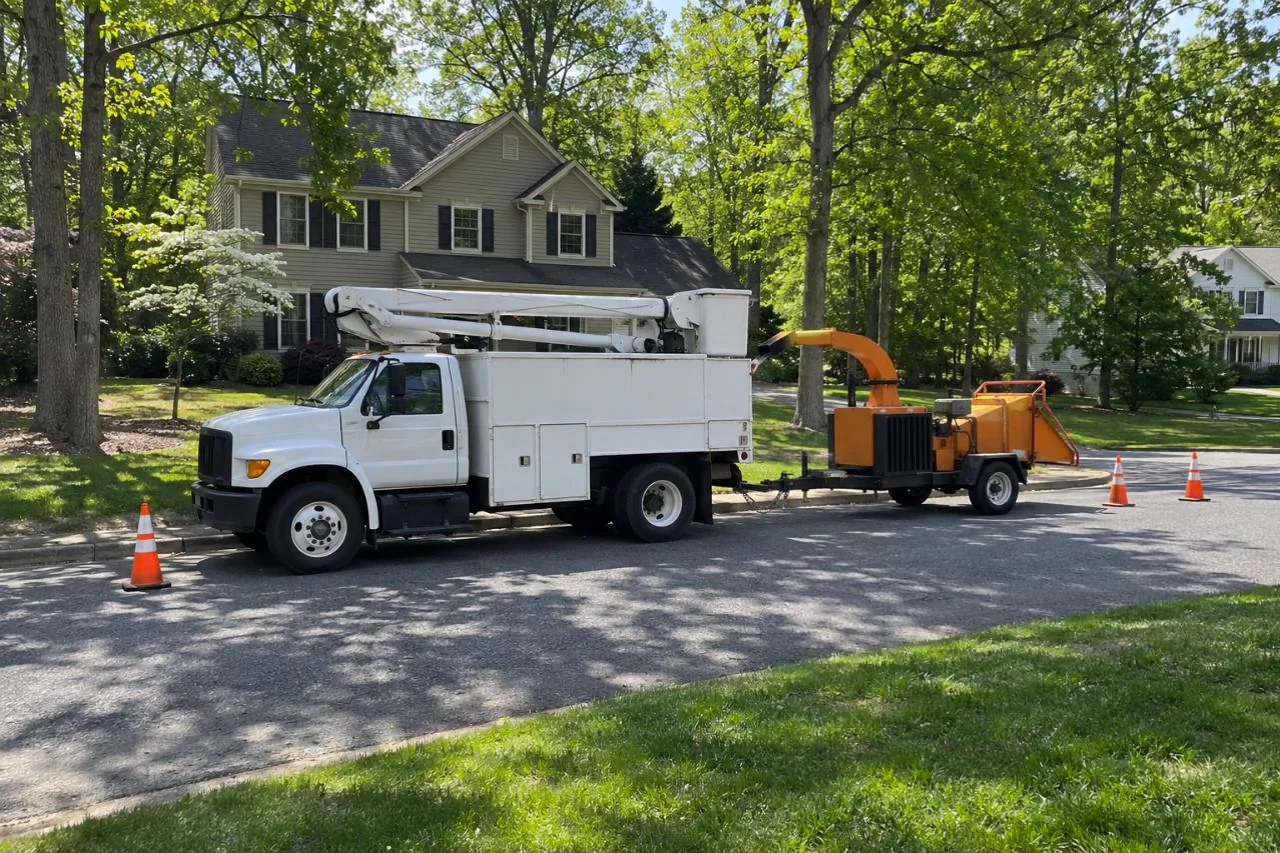
Who does tree work here
- Tree companies. Climbers, bucket trucks, chippers and sometimes cranes, for removal, trimming and storm work around houses.
- Stump grinding outfits. Some outfits only grind stumps; others do both removal and grinding.
- Utility line crews. Rappahannock Electric Cooperative and Dominion Energy clear their own lines and rights-of-way. REC cleared 1,800 miles of right-of-way and removed 2,400 hazard trees in 2025 (REC annual report, checked Nov 10, 2026). Those crews work for the utility, not for you, and after Dominion's maintenance trimming the larger limbs and trunks stay with the property owner (checked Nov 10, 2026).
- Land clearing operations. For clearing a wooded lot for a house or pasture with heavy equipment. Disturbing more than 2,500 square feet needs a county land disturbance permit (checked Nov 10, 2026).
- Tree care for a living tree. Treating an ash for emerald ash borer, for example, which the Virginia Department of Forestry says can work if it starts before more than 30 percent of the canopy is damaged (July 2018).
What the job involves
A typical removal or trim here runs like this. The contractor visits and looks at the tree, the ground under it, the wires, and how a truck or crew reaches it. You get a written scope and price. If the tree is in a stream buffer, county approval comes next. If a stump is being ground, someone places a Virginia 811 request at least three working days ahead (checked Nov 10, 2026). On the day, the crew sets up, takes the tree down by the method agreed, and cleans up as written.
Local questions worth raising
These are the Spotsylvania-specific points that change the plan, the price or the paperwork (all checked Nov 10, 2026):
- Is the tree within about 100 feet of a year-round stream, pond or wetland? If it's in a Resource Protection Area, all removal needs county approval: simple administrative approval for one to five dead, diseased or storm-damaged trees, and a permit application with a replanting plan for more. Agree on who sends the request, with its photos, removal method and written request, to Environmental Codes at 540-507-7222.
- Is it within 25 feet of the shoreline? Then the county's guidance is that the stump stays.
- Is the trunk in VDOT's right-of-way? State rules require a single use permit before trimming or cutting it.
- Are there wires within 10 feet? State law requires notifying the line's owner first. Dominion will disconnect a service line at no cost so the work can be done safely.
- Who places the 811 request, and who flags the private lines? Utilities reached through Virginia 811 don't mark private lines, such as lines to a shed, septic and propane lines, or a line from a private well.
- Where does the wood go? No curbside pickup; Livingston Landfill takes no stumps and no logs over 18 inches across; burning is limited to small limbs far from buildings.
- Does your HOA need to approve it? Check your covenants.
- Is the lot in the City of Fredericksburg or on Lake Anna? The city has its own buffer permit ($50 plus $25), and local sources say Dominion Energy owns the Lake Anna shoreline.
Questions to ask about the job
- How will this tree come down, and where will each piece land?
- What protects the roof, deck, fence, driveway and septic field?
- What equipment comes onto the lawn, and what happens if the ground is soft?
- Is the stump included? How deep is it ground, and what happens to the grindings?
- Are the limbs chipped and hauled, and is the trunk hauled or left as firewood?
- What happens if the crew finds rot, rock or a buried line once work starts?
- When can the work happen, and about how long will it take?
- What's the total, and when is each part due?
Clear answers name a method, a landing spot and a cleanup standard. Vague ones, like "we'll handle it," leave room for surprises.
What the written agreement should say
- Your name and address, the contractor's name and address, and the date.
- Each tree by location, and what happens to it: removed, trimmed or left.
- The method, the landing zones, and how nearby structures are protected.
- Who applies for any county stream-buffer approval, VDOT permit or HOA approval, and who does any required replanting.
- Who places the Virginia 811 request.
- Stump grinding: yes or no, depth, and what happens to the grindings.
- Wood and brush: chipped, hauled, or cut and stacked.
- Cleanup: raking, ruts, debris left behind.
- The total price, the payment schedule, and what would change the price.
- If a deposit is asked for, the amount, what it covers and when the balance is due.
For a sale made at your home without a prior invitation or appointment, Virginia also requires a "BUYER'S RIGHT TO CANCEL" notice, covered next.
Door-to-door offers and your three business days
The Virginia Home Solicitation Sales Act covers consumer sales of goods or services made in person, by phone or electronically at the buyer's home "without prior invitation or appointment." Cash sales under $25 and sales after prior negotiations are among the exclusions (Va. Code § 59.1-21.2, checked Nov 10, 2026). Where it applies:
- You can cancel until midnight of the third business day after signing, by written notice to the seller's address in the agreement. Mailed notice counts when it's mailed, and any written statement that you don't intend to be bound is enough (§ 59.1-21.3).
- The contract must say so. "BUYER'S RIGHT TO CANCEL" in bold, 10-point or larger type, on the front or just above the signature, with a Notice of Cancellation form. Until the seller complies, you may cancel in any manner (§ 59.1-21.4).
- Your money comes back. After a cancellation the seller must return all payments within 10 days, and isn't owed anything for services performed before the cancellation (§§ 59.1-21.5 and 59.1-21.6).
- Misleading sellers get longer. If a seller doesn't identify itself as a seller or misstates its purpose, the buyer has 30 days to cancel (§ 59.1-21.7).
- Violations are prohibited practices under the Virginia Consumer Protection Act (§ 59.1-21.7:1).
The emergency exception. After a storm, a crew may ask you to waive the three days. The right to cancel doesn't apply only when you requested immediate service because of an emergency and all three of these are true: the seller has in good faith substantially begun the work, any goods can't be returned in substantially as good condition, and your emergency request is in a dated writing you personally signed that expressly says you understand you're waiving the right to cancel (§ 59.1-21.3, checked Nov 10, 2026). Read anything a crew hands you to sign after a storm before you sign it.
Prices after a declared emergency
Virginia's Post-Disaster Anti-Price Gouging Act applies after a disaster that leads to a state of emergency declared by the Governor or the President. Its list of "necessary goods and services" expressly includes "tree removal supplies and services," along with emergency cleanup. Protection lasts for the longer of the emergency or 30 days after the event, and longer if the emergency is renewed (Va. Code §§ 59.1-525 to 59.1-529.1, checked Nov 10, 2026).
There's no fixed percentage cap. Whether a price is unconscionable turns on four factors: whether it grossly exceeded the price in the 10 days before the disaster, whether it grossly exceeded prices readily available in the area in those days, whether the increase came only from the supplier's added costs, and whether it was only a regular seasonal adjustment. The law doesn't create a private right to sue; enforcement goes through the Consumer Protection Act, and the Governor can order a supplier to lower prices to the prevailing local market price for up to 30 days (§§ 59.1-527 to 59.1-529.1, checked Nov 10, 2026).
Where to report a problem
The Office of the Attorney General's Consumer Protection Section runs a hotline at 804-786-2042, 8:30 a.m. to 5:00 p.m. weekdays, and takes complaints online through its complaint form. The office's main line is 804-786-2071 (checked Nov 10, 2026).
Where hiring goes wrong
- A one-line scope. "Remove tree" leaves the stump, the brush and the ruts open to argument.
- Nobody owning the buffer approval. If the tree is near a creek, decide in writing who asks the county.
- Waiving the three days under pressure. The emergency exception has strict conditions for a reason.
- Handing over the full price up front. A clear payment schedule protects both sides.
- No plan for the wood. Pieces too big for Livingston can sit in the yard.
- Grinding without a locate. The 811 request comes first.
Hiring questions
What should a written tree removal agreement include?
The trees and what happens to each, the method and landing zones, who handles any county, VDOT or HOA approval, who places the 811 request, the stump, the wood, the cleanup, and the price and payment schedule.
Can I cancel a contract I signed with someone who knocked on my door?
Usually, until midnight of the third business day after signing, by written notice. The exception is an emergency where you asked for immediate service, the work had substantially begun, and your request was a dated writing you signed that waives the right to cancel (Va. Code § 59.1-21.3, checked Nov 10, 2026).
Who gets the county's approval for a tree near the stream?
Whoever you agree on; write it down. The county wants photos of the trees and their location in the buffer, the removal method, how the remaining vegetation will be protected, and a written request (checked Nov 10, 2026).
Is it normal to be asked for a deposit?
Some contractors ask for one. If so, the agreement should give the amount, what it covers and when the rest is due.
Where can I complain about a tree contractor?
The Attorney General's Consumer Protection hotline, 804-786-2042, or its online complaint form (checked Nov 10, 2026).
This site sends each request to one independent contractor who works in Spotsylvania County. The agreement, the price and the work are between you and that contractor; the site does no tree work.
Sources
- Virginia Home Solicitation Sales Act, Va. Code §§ 59.1-21.1 to 59.1-21.7:1; Virginia Post-Disaster Anti-Price Gouging Act, Va. Code §§ 59.1-525 to 59.1-529.1; Office of the Attorney General, Consumer Protection Section. Checked Nov 10, 2026.
- Spotsylvania County, Dead, Diseased, and Dying Vegetation and General Woodlot Management handouts, Environmental page and Yard Waste Collection Program. Checked Nov 10, 2026.
- 24VAC30-151-30; Va. Code §§ 59.1-406 et seq.; Dominion Energy, tree trimming and power lines; Virginia 811, homeowners, private utilities and excavators pages. Checked Nov 10, 2026.
- Rappahannock Electric Cooperative, 2025 Annual Report (checked Nov 10, 2026); Virginia Department of Forestry, Ash Tree Management (FT0035, July 2018); City of Fredericksburg, RPA Buffer Modification permit form (checked Nov 10, 2026).