
Do you need a permit?
For most homes, no. Spotsylvania has no incorporated towns, so the county's rules cover every community from Massaponax and Lee's Hill to Partlow and Thornburg. The county code and county web pages show this (checked Nov 10, 2026):
- An ordinary yard tree. No county permit for removing a tree from an existing single-family lot turned up in the zoning chapters. Single-family detached homes are exempt from site plan approval under Sec. 23-4.4.2, and the zoning code's landscaping division applies to development where site plans or generalized development plans are filed (Sec. 23-5.5.2).
- A buffer drawn on your plat. If the recorded subdivision plat or site plan shows a buffer or tree-save area, check with the county Planning office first. Whether those areas bind a later homeowner wasn't confirmed.
- A big patch of bare ground. Disturbing more than 2,500 square feet of land, for instance grubbing out stumps across a large area, needs a county land disturbance permit. Protected areas can carry limits even below that size.
- Near a stream. Inside a Resource Protection Area, every tree removal needs county approval. The next section explains it.
- Your homeowners association. If your subdivision has an association, its covenants or architectural review may say something about removing trees. Read them before the crew is booked.
- Inside the City of Fredericksburg. The city is independent of the county and runs its own buffer permit. The rules guide covers it briefly.
Trees within 100 feet of a stream
Spotsylvania's streams drain to the Rappahannock and York rivers and on to the Chesapeake Bay, and the county enforces the state's Chesapeake Bay Preservation Act through Chapter 6A of the county code. A Resource Protection Area includes water bodies with year-round flow, the nontidal wetlands connected to them, and a buffer taking in land within 100 feet of those features and land in a major floodplain (checked Nov 10, 2026).
The county's handout on dead, diseased and dying vegetation puts it in one line: "All tree removal is subject to approval from local government." It then sets two tiers (checked Nov 10, 2026):
| What you want to remove in the buffer | What the county asks for |
|---|---|
| One to five dead, diseased or storm-damaged trees, or invasive plants | Simple administrative approval |
| More than five trees, or large areas of invasive plants | A permit application, with a plan showing the location, size and species of replacement trees, shrubs and groundcover, plus a maintenance schedule |
| Healthy trees, to make lawn or open the view | Clearing native vegetation to create lawn isn't allowed; sight lines need approval and replacement planting |
County staff may schedule a visit, and one is required for thinning or intensive removal. A tree within 25 feet of the shoreline should stay unless it threatens to undermine the bank, and if one there has to come down, the stump stays in the ground to hold the soil. Violations can bring civil penalties of up to $5,000 per day, plus a restoration plan approved by Environmental Codes (checked Nov 10, 2026).
Call the county's Division of Environmental Codes at 540-507-7222 before anyone cuts. The county's RPA page also lists 540-507-7219 (both checked Nov 10, 2026). The rules guide covers what an application needs and the replanting rates.
Tall poplars and oaks beside houses
Where a lot backs onto woods, the trees at the edge are often the tallest on the property. NC State Extension lists tulip poplar at 80 to 120 feet, white oak at generally 80 to 100 feet, and southern red oak at 60 to 100 feet (checked Nov 10, 2026). A tree that size can only be dropped in one piece when there's clear, open ground longer than the tree is tall in the direction it will fall. Next to a two-story house, a fence and a neighbor's shed, there usually isn't.
The contractor chooses among three basic methods after walking the lot:
- Felling whole. A notch cut on the side the tree should fall toward, a back cut on the opposite side, and the trunk goes down along that line. It suits open acreage on the county's rural roads far better than a quarter-acre backyard.
- Taking it down in sections. A climber or a bucket truck removes the limbs, then the trunk in short lengths. Pieces above a roof, deck or fence are tied off and lowered on rope.
- Crane removal. When a big tree leans over the house and nothing can be lowered safely, a crane lifts sections out. Whether one can set up depends on the driveway, overhead wires and how firm the ground is.
Ask which method the crew plans and exactly where each piece will land. A good answer names the landing spot and what protects whatever sits beside it.
Red clay, wet winters and rock
The ground under a Spotsylvania yard changes how a removal goes. The USDA's official description of the Mattaponi soil series gives Spotsylvania County as its type location. It's very deep, with a subsoil of brownish-yellow to reddish-yellow clay to sandy clay loam, moderately slow permeability, and a seasonal high water table 36 to 72 inches down from December to March (USDA soil series description, revised October 2021).
In practice, a loaded bucket truck or a crane outrigger can rut a soft lawn in late winter. The crew may lay ground mats, bring a smaller machine, or wait for a drier week. Elsewhere in the Virginia Piedmont the soils run from deep red clay, like the Cecil series, to shallow ground like the Louisa series, which reaches rock about 21 inches down in its typical profile. Which of those are mapped on your street wasn't confirmed; the stump hole usually tells.
Soil also matters for the trees that stay. The University of Florida's storm guide says cutting roots, compacting soil, shallow soil and a high water table all make a tree more likely to blow over, and it warns never to cut roots closer than 5 times the trunk diameter. NC State Extension notes that white oak is sensitive to soil compaction. Keep trucks and log piles off the root zone of the oak you want to save.
Wires and the line to the house
Virginia's Overhead High Voltage Line Safety Act bars anyone from doing work that brings a person or equipment within 10 feet of an overhead high-voltage line unless the danger is guarded against. The line's owner must be notified, and it has five working days to begin safety arrangements. Civil penalties go up to $1,000, and a violator who causes damage must cover the operator's losses (Va. Code §§ 59.1-408 to 59.1-414, checked Nov 10, 2026).
The wire from the pole to your house is a separate case. Dominion Energy says it trims only limbs rubbing hard against a service line, does not cut down live or dead trees on or near it, and will disconnect the service line at no cost so the owner's contractor can work safely (checked Nov 10, 2026). Rappahannock Electric Cooperative serves other parts of the county; your bill shows which company is yours. REC's 24-hour line is 800-552-3904 (checked Nov 10, 2026).
Where the wood goes
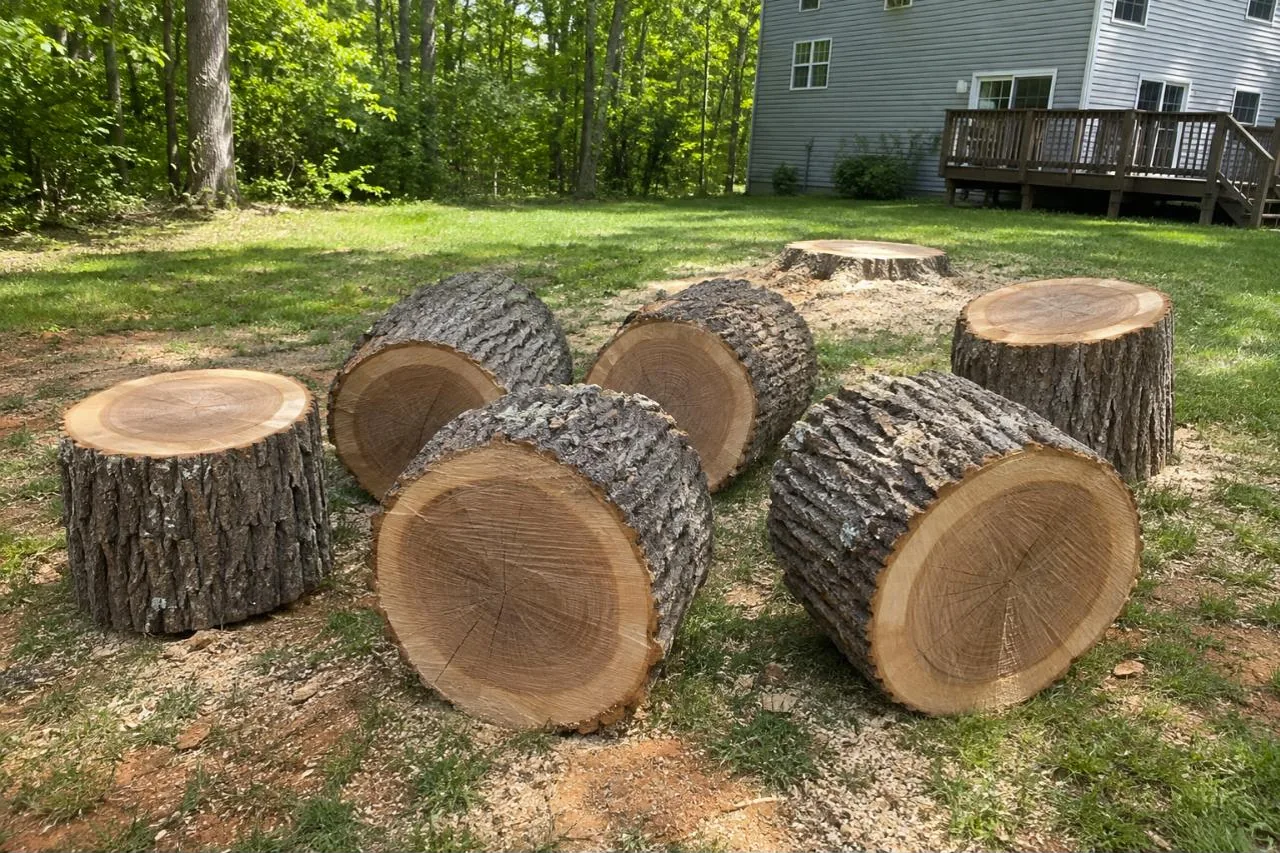
One big oak or poplar leaves trunk rounds, heavy limbs and a heap of brush. The county runs no curbside pickup, so it all has to be hauled somewhere or used on the property (checked Nov 10, 2026).
- Convenience centers. The Chancellor Convenience Center (5917 Harrison Road) and the Berkeley Convenience Center (6043 Stanfield Road) accept brush, leaves, shrubs and limbs under 6 inches thick and under 6 feet long, loaded no more than 4 feet above the deck. They serve county residents, the vehicle needs a Spotsylvania refuse decal, and it's one load a day (checked Nov 10, 2026).
- Livingston Landfill. Wood thicker than 6 inches or longer than 6 feet, and bulk chips, go only to Livingston at 6241 Massey Road. It must be clean, with no logs over 18 inches across or 12 feet long. Decal holders in residential vehicles, or towing trailers 16 feet or shorter with sides under 30 inches, dump brush without a tipping fee; commercial vehicles are weighed and charged (checked Nov 10, 2026).
- No stumps anywhere. The county says stumps aren't accepted at any refuse facility (checked Nov 10, 2026), so they're ground in place or hauled off by the contractor.
- Burning. County guidelines limit a homeowner to limbs 2 inches or thinner, in a pile no bigger than 4 by 4 by 4 feet, set 300 feet from any structure (50 feet in A-3 zoning), after notifying dispatch and the Fire Prevention Division (checked Nov 10, 2026). Unless the lot can put 300 feet between the pile and every building, burning is off the table.
- Keeping it. Trunk rounds cut to firewood length, or chips spread on beds, mean less to haul.
The stump
The stump is a separate decision. Virginia 811 lists removing old stumps among the jobs that need a locate request, made at least three working days before the work (checked Nov 10, 2026). Inside the stream buffer, a stump within 25 feet of the shoreline stays put. The stump grinding guide has the rest.
Where removals go wrong
- Cutting in the buffer without approval. A dead tree by the creek still needs the county's say first, and a penalty can run up to $5,000 a day (checked Nov 10, 2026).
- Too little room to fell. A trunk taller than the open ground in front of it lands on something.
- Wires treated as an afterthought. Limbs tangled in the service drop come down only after the utility has disconnected or covered it.
- Brush nobody planned for. Without hauling in writing, a log pile can sit in the yard for months, and pieces over 18 inches across won't go to Livingston (checked Nov 10, 2026).
- Hurting the trees that stay. Ruts, compaction and cut roots around a kept oak can bring it down years later.
- Grinding before the locate. Skipping Virginia 811 risks a buried line.
Published removal prices
Thumbtack's tree removal cost guide, last updated March 24, 2026, sets the national average for taking down one tree at $450 to $1,450, or $884 to $1,627 once stump removal is added (checked Nov 10, 2026). It prices by trunk diameter and canopy instead of height: a slim trunk, under a foot thick with a canopy narrower than 30 feet, averages $226 to $596; $808 to $2,132 for a 12- to 24-inch trunk under a canopy wider than 30 feet, and $1,562 to $4,117 at the top of its table. Lawn Love's 2026 guide, which cites no data source, gives $1,160 to $2,000 for trees over 80 feet (checked Nov 10, 2026). These are national figures, not Spotsylvania prices; the contractor's written price for your tree is the one that counts. Every tier is listed on the page about what tree work costs.
When another guide fits better
If a healthy oak only crowds the roof, trimming may do the job. A tree already on the house belongs under storm and emergency removal. Browning or storm-bent pines have their own guide, pine tree removal. Clearing a wooded lot for a new house is land clearing, where the county's 2,500-square-foot land disturbance threshold comes into play (checked Nov 10, 2026).
Removal questions
Can I take down a dead tree by the creek behind my house without asking anyone?
Not if it's within the Resource Protection Area. The county requires approval for all tree removal there; for one to five dead, diseased or storm-damaged trees it's a simple administrative approval. Call Environmental Codes at 540-507-7222 first (checked Nov 10, 2026).
Is a permit needed for a tree in my front yard by the road?
Not from the county for an ordinary yard tree. If the trunk stands in VDOT's right-of-way, though, state rules require a single use permit before trimming or cutting it (24VAC30-151-30, checked Nov 10, 2026).
When can a tree be dropped in one piece?
Only when there's open ground in its path longer than the tree is tall. Picture, for example, a 90-foot poplar with only 50 feet of open lawn between its trunk and the house: a tree like that would have to come down in sections instead, which takes longer but spares the roof.
Is it all right to keep the logs for firewood?
Yes, in most cases. Have the crew buck the trunk into stove-length rounds and leave them stacked; hauling less wood away can trim the bill.
My house is inside Fredericksburg city limits. Do county rules apply?
No. The city has its own code, its own Resource Protection Area permit, and a City Arborist who handles city-owned street trees. See the city section of the rules guide.
One independent contractor who works in Spotsylvania County does the cutting.
Sources
- Spotsylvania County, What is a Resource Protection Area?, What can I do in an RPA?, Chesapeake Bay Preservation and the Dead, Diseased, and Dying Vegetation handout. Checked Nov 10, 2026.
- Spotsylvania County Code Chapter 23, Article 4 and Article 5; county Environmental page. Checked Nov 10, 2026.
- NC State Extension Gardener Plant Toolbox, tulip poplar, white oak and southern red oak. Checked Nov 10, 2026.
- USDA official soil series descriptions, Mattaponi, Cecil and Louisa; UF/IFAS, Wind and Trees: Lessons Learned from Hurricanes (FR173).
- Virginia Overhead High Voltage Line Safety Act; Dominion Energy, tree trimming and power lines; Rappahannock Electric Cooperative, contact page; 24VAC30-151-30. Checked Nov 10, 2026.
- Spotsylvania County, Yard Waste Collection Program, Solid Waste Center Information and Burning Guidelines; Virginia 811, homeowners page. Checked Nov 10, 2026.
- Thumbtack, Tree Removal Cost Guide 2026, updated March 24, 2026; Lawn Love, How Much Does Tree Removal Cost in 2026?, updated October 5, 2026. Both checked Nov 10, 2026.