
The short version
| Your situation | Who has a say | What's needed |
|---|---|---|
| An ordinary yard tree, no year-round stream within 100 feet | No county permit found | Check your HOA covenants and any buffer shown on your plat |
| One to five dead, diseased or storm-damaged trees in a Resource Protection Area | County Division of Environmental Codes | Simple administrative approval |
| More than five trees in a Resource Protection Area | Environmental Codes | Permit application with a replanting plan |
| Disturbing more than 2,500 square feet of ground | County | Land disturbance permit |
| A tree in VDOT's right-of-way | VDOT | Single use permit before trimming or cutting |
| Work within 10 feet of a high-voltage line | The line's owner | Notice and safety arrangements first |
| Lake Anna shoreline | Dominion Energy, as local sources describe it | Check with Dominion before cutting near the water |
| A buffer tree inside the City of Fredericksburg | City Community Planning and Building | RPA buffer modification permit, $50 plus $25 processing |
An ordinary yard tree
Spotsylvania has no incorporated towns, so county rules apply everywhere in it. The zoning chapters read for this site show no permit for removing a tree from an existing single-family lot (checked Nov 10, 2026). Single-family detached homes are exempt from site plan approval (Sec. 23-4.4.2), the zoning code's landscaping division applies to "all development where generalized development or site plans are filed" (Sec. 23-5.5.2), and the old tree cover and tree preservation credit sections were repealed by Ordinance 23-141.
Three things can still apply: a buffer or tree-save area drawn on your recorded plat (ask the county Planning office; whether one binds a later owner wasn't confirmed for this site), your HOA's covenants, and the county's land disturbance permit for disturbing more than 2,500 square feet, such as grubbing stumps across a large area (checked Nov 10, 2026).
What a Resource Protection Area is
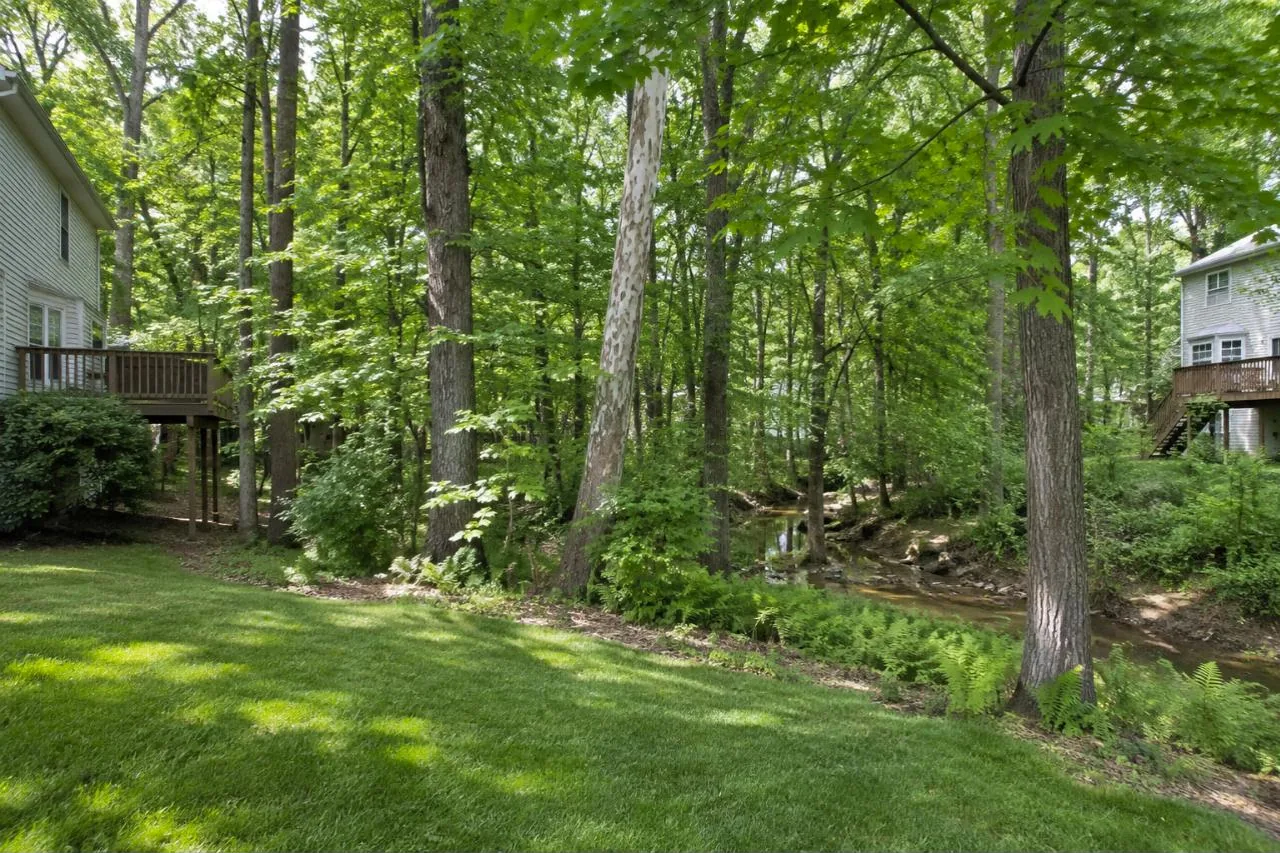
The county describes Resource Protection Areas as environmentally sensitive land along streams, rivers and other waterways that drain to the Rappahannock and York rivers and the Chesapeake Bay, governed by its Chesapeake Bay Preservation Ordinance, Chapter 6A of the county code. An RPA includes (checked Nov 10, 2026):
- tidal wetlands and tidal shores,
- water bodies with perennial, or year-round, flow,
- nontidal wetlands connected to those, and
- a buffer area that takes in land within a major floodplain and land within 100 feet of those features.
The county keeps guidance maps showing roughly where RPAs lie, and only the county makes the definite call. Under the state regulation, 9VAC25-830-140 (last amended effective September 25, 2024), buffer vegetation that slows runoff, prevents erosion and filters pollution must be kept where it exists, and a buffer is deemed to achieve 75% sediment reduction and 40% nutrient reduction.
What's allowed in the buffer
The county says removing vegetation or disturbing land in the buffer generally requires county approval. Removal is allowed for four purposes (checked Nov 10, 2026):
- Sight lines, woodlot management and habitat management, with what's removed replaced by vegetation that protects water quality as well.
- Access paths that don't cause erosion.
- Dead, dying or diseased trees and shrubs, noxious weeds and invasive plants, replaced with equally effective plantings.
- Shoreline erosion control, with the buffer re-established in native woody plants.
Not allowed: clear-cutting, removing native vegetation to make lawn, expanding lawns or gardens without a waiver or exception, and sheds, gazebos, pools or detached garages without an exception approved at a public hearing (checked Nov 10, 2026).
Penalties. The county can impose civil penalties of up to $5,000 per day, plus an RPA restoration plan approved by Environmental Codes (checked Nov 10, 2026).
Getting approval to remove trees in the buffer
The county's handouts on dead, diseased and dying vegetation and on woodlot management set out the process (both checked Nov 10, 2026). The first starts bluntly: "All tree removal is subject to approval from local government."
- One to five trees. Removing one to five dead, diseased or storm-damaged trees, or invasive plants, needs simple administrative approval.
- More than five. More than five trees, or large areas of invasives, need a permit application, with a plan showing the location, size and species of replacement trees, shrubs and groundcover and a maintenance schedule. The handout suggests consulting an arborist or horticulturist.
- What to send. Photos of the vegetation and where it stands in the buffer, how it will be removed, how the remaining vegetation will be protected, and a written removal request.
- A site visit. Staff may schedule one; it's required for thinning or intensive removal.
- Hazards. Dead trees or logs may be removed if they pose a fire or falling hazard, and diseased or infested trees if the problem threatens other trees and chemical control would harm nearby water.
- The shoreline. Trees within 25 feet of the shoreline should stay unless they threaten to undermine it. If one there must come down, the stump stays to hold the soil.
- Wildlife and understory. If a hazardous tree holds nesting birds or bats, the U.S. Fish and Wildlife Service can advise. Removing understory trees, shrubs and leaf litter isn't permitted.
The county's RPA exemption and exception request form, updated February 13, 2024, has a section 6A-12(d) checkbox for "Buffer Area – (Request to remove vegetation)," and staff may ask for a site visit. Send it to the Environmental Codes Division, 9019 Old Battlefield Blvd., 1st Floor, Spotsylvania, VA 22553; (540) 507-7222; eereviews@spotsylvania.va.us. The county's RPA page also lists 540-507-7219 for the division, and no fee appears on the form (all checked Nov 10, 2026).
Replanting rates
When removal calls for mitigation, the county's mitigation plans handout sets the rates (checked Nov 10, 2026). For buffers of a quarter acre (10,890 square feet) or less, it lists these plantings for every 400-square-foot unit, 20 by 20 feet, or fraction of it:
| Layer | What the handout lists per 400 square feet |
|---|---|
| Canopy | One canopy tree (1.5 to 2 inch caliper) or a large evergreen (6 feet) |
| Understory | Two understory trees (0.75 to 1.5 inch caliper) or 4-foot evergreens, or one understory tree plus two large shrubs (3 to 4 feet) |
| Shrubs | Three small shrubs or woody groundcover (15 to 18 inches) |
Environmental Codes confirms the mix your plan needs. Native species are preferred, and B-grade stock is acceptable. Buffers larger than a quarter acre may use bare-root seedlings at 1,210 stems per acre or tubes at 700 per acre in the landward half of the buffer, from 50 to 100 feet inland, each with a minimum number that must survive two growing seasons (checked Nov 10, 2026).
Reservoir overlays
The zoning code's Reservoir Protection Overlay keeps a buffer at least 150 feet wide from a designated reservoir's mean high water line, and 75 feet along perennial streams, in ground cover vegetation; other vegetation needs prior county approval (Secs. 23-7.5.3 and 23-7.5.4, checked Nov 10, 2026). The county's reservoirs include Ni River and Hunting Run, so ask the Planning office whether your lot falls in an overlay.
Lake Anna
The county's southern edge runs along Lake Anna. Local sources, not Dominion's own pages, describe Dominion Energy as owning the shoreline land up to a set high-water mark and say removing shoreline vegetation needs Dominion's prior approval. Check with Dominion before cutting trees near the water; the county's Resource Protection Area rules can apply as well. (Checked Nov 10, 2026.)
Trees along state roads
No work of any kind is allowed on a state highway or VDOT-controlled right-of-way "until written permission has been obtained from VDOT," and a single use permit is required before "trimming or cutting any trees located within the right-of-way." The district roadside manager may handle those requests (24VAC30-151-20 and -30, checked Nov 10, 2026). To report a tree down on a state road, the county's VDOT Resources page links to my.vdot.virginia.gov (checked Nov 10, 2026).
Power lines and the 10-foot rule
Virginia's Overhead High Voltage Line Safety Act bars work that puts a person or equipment within 10 feet of an overhead high-voltage line unless the danger is guarded against. The line's owner must be notified and has five working days to begin safety arrangements, and civil penalties reach $1,000 (Va. Code §§ 59.1-408 to 59.1-412, checked Nov 10, 2026). Dominion Energy will disconnect a service line at no cost so the owner's contractor can work safely, and Rappahannock Electric Cooperative takes calls at 800-552-3904 (both checked Nov 10, 2026). The trimming guide covers what each utility trims.
Virginia 811
State law requires a locate request before any excavation (Va. Code § 56-265.17), and Virginia 811 lists removing old stumps among jobs that need one. Call 811 at least three working days ahead; the locate service is free (checked Nov 10, 2026). The stump grinding guide has the full rules.
Burning: the 4 p.m. law and county rules
The state law. From February 15 through April 30, burning brush, leaves or debris within 300 feet of woodland, brushland or dry grass is allowed only from 4:00 p.m. to midnight, and a fire within 150 feet of them can't be left unattended. A violation is a Class 3 misdemeanor, with a fine of not more than $500 according to the Department of Forestry, and if it causes a forest fire the violator owes the state the cost of suppressing it (Va. Code § 10.1-1142, checked Nov 10, 2026).
The county's guidelines for yard waste from a home (checked Nov 10, 2026):
- Leaves, grass, garden trimmings and limbs 2 inches thick or less; for anything else, call the Fire Marshal's Office at 540-507-7925 first.
- A pile no larger than 4 by 4 by 4 feet, attended the whole time, with water or hand tools and a phone on hand.
- At least 300 feet from any structure, or 50 feet in A-3 zoning.
- Before lighting, notify the non-emergency dispatch line at (540) 582-7115 and the Fire Prevention Division at 540-507-7925 with the address and start and end times.
- Breaking the county burn ordinance is a Class 1 misdemeanor: up to 12 months in jail, a fine up to $2,500, or both.
Land-clearing debris such as stumps and logs needs Fire Marshal approval, can't be burned from May 1 to October 1 under state rules, and may need a $150 open-air burning permit depending on zoning (checked Nov 10, 2026). For a tree on a typical home lot, chipping and hauling are the realistic options.
Convenience centers and Livingston Landfill
The county doesn't offer curbside pickup, and stumps aren't accepted at any county refuse facility. The centers serve county residents, and the vehicle needs a Spotsylvania refuse decal (checked Nov 10, 2026).
- Chancellor Convenience Center, 5917 Harrison Road, and Berkeley Convenience Center, 6043 Stanfield Road: brush, leaves, grass, shrubs and limbs under 6 inches in diameter and under 6 feet long, loaded no more than 4 feet above the deck. One load a day.
- Livingston Landfill, 6241 Massey Road: yard waste plus clearing debris, meaning wood over 6 inches across or 6 feet long and bulk chips. It must be clean, with no logs over 18 inches in diameter or 12 feet long. Residential vehicles with a decal, and trailers 16 feet or shorter with sides under 30 inches, dump brush without a tipping fee; commercial vehicles pay a commercial brush rate.
Hours change by season, so check the county's Solid Waste Center Information page before a trip, or call Solid Waste and Recycling at 540-507-7739 (checked Nov 10, 2026).
The City of Fredericksburg
The City of Fredericksburg is an independent city with its own code, so the county rules above don't apply inside it. In brief (all checked Nov 10, 2026):
- Buffer trees. The city's RPA Buffer Modification permit, under City Code 72-34.5, covers removing dead, diseased or dying trees, thinning, sight lines and shoreline erosion control. It costs a $50 application fee plus a $25 processing fee, nonrefundable, and needs a site drawing, though date-stamped photos can stand in for very minor removal. Community Planning and Building, 601 Caroline St., 540-372-1179.
- Specimen trees. The city's specimen tree rules (§ 72-55.6B, amended in 2024) apply to development, and existing single-family homes on lots of record created before October 8, 2013 are exempt.
- Street trees. The City Arborist, 540-372-1023, handles questions about city trees in the right-of-way, and routine city removals are marked on the tree at least a week ahead.
- The historic district. Exterior changes in the city's historic district need a Certificate of Appropriateness (COA), a historic-district approval from the city's Architectural Review Board. The city's Historic District Guidelines, adopted July 13, 2021, say "A COA is not required for repainting of painted surfaces, gardening and landscaping." Tree removal isn't named, so confirm with Community Planning and Building at (540) 372-1179.
Questions about the rules
Do I need a permit to take down a tree in my Spotsylvania yard?
Not from the county for an ordinary tree on an existing home lot, unless it's inside a Resource Protection Area, a buffer on your plat, or VDOT's right-of-way (checked Nov 10, 2026). Your HOA may have its own rules.
How do I find out if my lot is in a Resource Protection Area?
The county's guidance maps show roughly where RPAs are, but only the county makes the definite call. Contact Environmental Codes at 540-507-7222 or eereviews@spotsylvania.va.us (checked Nov 10, 2026).
What happens if someone cuts trees in the buffer without approval?
The county can impose civil penalties of up to $5,000 per day and require a restoration plan (checked Nov 10, 2026).
A request sent from this site goes to one independent contractor who works in Spotsylvania County; any county approval is arranged between you and that contractor. The site itself does no tree work.
Sources
- Spotsylvania County, What is a Resource Protection Area?, What can I do in an RPA?, Chesapeake Bay Preservation, Environmental; handouts Dead, Diseased, and Dying Vegetation, General Woodlot Management and Mitigation Plans; RPA Exemption/Exception Request form. Checked Nov 10, 2026.
- Spotsylvania County Code Chapter 23, Article 4, Article 5 and Article 7; 9VAC25-830-140. Checked Nov 10, 2026.
- Lake Anna Online, March 6, 2025, and Lake Anna Civic Association, October 2024 newsletter, on Dominion's shoreline ownership and vegetation policy.
- Dominion Energy, Lake Anna and tree trimming and power lines; Rappahannock Electric Cooperative, contact page. Checked Nov 10, 2026.
- 24VAC30-151-20 and 24VAC30-151-30; Spotsylvania County, VDOT Resources; Va. Code §§ 59.1-406 et seq.; Va. Code § 56-265.17; Virginia 811, homeowners page. Checked Nov 10, 2026.
- Va. Code § 10.1-1142; Virginia Department of Forestry, 4 PM Burning Law; Spotsylvania County, Burning Guidelines, Yard Waste Collection Program and Solid Waste Center Information. Checked Nov 10, 2026.
- City of Fredericksburg, RPA Buffer Modification permit form (revised February 10, 2026), City Code § 72-55.6B, Urban Forestry, Urban Tree Management and Historic District Design Guidelines. Checked Nov 10, 2026.